

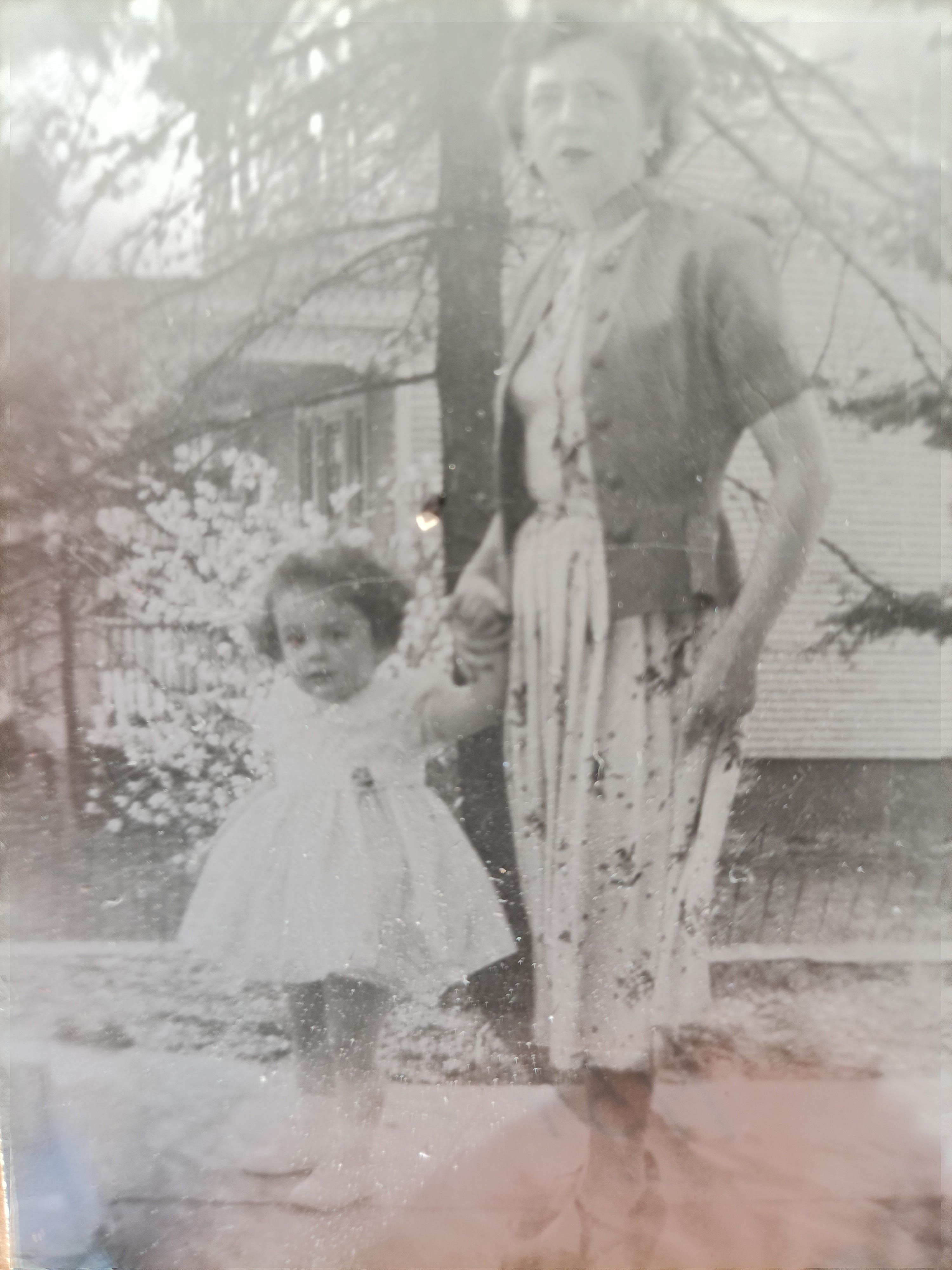
Every house was different, every single one, and I liked to go in them all. While I could have never expressed it at the time, going from house to house, from neighbor to neighbor, I was measuring socioeconomic differences up and down the block. Socioeconomic and perhaps philosophical, ethical, and religious, as well. In those buoyant, long-ago 1950’s days, I certainly did not think in those terms, but the details I was picking up and tucking away have proved rich enough, dense enough, complex enough, to have provided a lifetime of food for thought.
I knew who had money and who did not. And I compared, compared neighbors to neighbors and compared them to me and my family. I also knew who would offer me food or not. Scavenger and busybody, I guess that’s how you could describe me as a child. I was also learning life lessons, circa 1950: envy, pity, and how and when to stay in my place. Above all, though this was not my intention, I was honing a wicked eye (wicked: Merriam Webster, definition 4).
I also remember all the names, but to protect the innocent, I’ll change them, make up new names, blurring lines between what is invented and what is real.
The Hornbergers and the Thomases were neighbors in the middle of the block, that block, the heart of the universe, Edwards Avenue on Greenwood Hill in Pottsville, Pennsylvania. The Hornbergers were old and they liked children. The Thomases were old too. Mrs. Thomas liked me. She offered me candied fruit, which I did not like, and hard candies dusted in powdered sugar, which I did. The Hornbergers offered graham crackers with a glass of milk. Gene the Milkman brought them more milk than they needed so they’d always have extra on hand for us.
The Hornbergers and the Thomases constitute an interesting comparative study. Both couples had money, more money than my family, in appearance and surely in reality in the case of the Thomases; in the case of the Hornbergers, in confident solidity, channeled into expansive generosity. The Thomases had a Cadillac Coupe de Ville, the only one in the neighborhood. The body was soft yellow, like melted butter, and it had a vinyl roof, creamy white, that made it look like a convertible. Even a kid could tell it outshined the other cars on the block. Mr. Thomas drove it to work, where he spent a lot of time. My memory imagines him a lawyer, but I could be wrong. Mrs. Thomas dressed and looked like the mothers on TV, but no grown children ever visited. Perhaps they lived far away. Perhaps adult children came and went, looking so grownup and independent, I did not recognize them for what they were.

Mrs. Thomas did not let just anyone inside. She let me in. Perhaps she could feel I loved her home. She had a long wraparound front porch. At one end was the entrance to the house. At the other, the porch extended out and then curved to reach the other side, wrapping itself around a turret rising to the attic. “Verandah,” a word I did not know at the time, would have been a better name than the more ordinary “front porch,” because hers was wider than others on the block and deliciously shaded in summertime.
Sometimes she invited me on the porch to sit with her on one of her padded deck chairs, pale yellow like the Cadillac. Sometimes we went into the living room. Once over the threshold, I let my feet sink into the thickest, plushest wall-to-wall carpeting I had ever experienced. I’ll admit, I hadn’t experienced much. At my house, we had area rugs, machine woven, in dark colors with oriental motifs. They were old and threadbare in spots.
Entering Mrs. Thomas’s home (I can’t remember having ever been introduced to Mr. Thomas though I did see him getting in and out of the Cadillac) was like stepping inside a TV show. Mrs. Thomas wore shirtwaist dresses with skirts that swooshed as she walked. She wore her hair in a stylish bun, with light bangs across her forehead. She always wore a string of pearls and a bracelet or two. And a touch of lipstick. Never too much, always tasteful. I evaluated her appearance based on aesthetics I’d learned from TV.
Her living room had built-in white shelves, filled with books and knickknacks. The sofa and armchairs were upholstered with green velvet, a color like pale emeralds, my favorite precious stones because May was my birthday month. In those days, nobody on the block had air conditioning, but because of the cedar and rhododendron bushes in the Thomases’ narrow front garden, the maples lining the street, and the wide verandah, in summer, when I did most of my visiting, it was always cool inside.
That living room was like a bower, another word I did not possess in those days. I fantasized that Mrs. Thomas would invite me to come over whenever I wished (when Mr. Thomas was not at home), to curl up in an armchair and read to my heart’s content in the cool shade and protection of her living room.
But she didn’t. Sometimes she showed me a vase filled with flowers she arranged very prettily. Sometimes she offered me a candy, which I accepted readily. Then she showed me to the door and I continued my way down the block.
How could the houses be so close together yet each one a threshold to a different world?
The Hornbergers lived next door and between their house and Mrs. Thomas’s was nothing more than an airway. Their house was a standard model in the coal region, three stories, four if you counted the cellar with its backdoor opening directly into the backyard. The first and second floors formed a long rectangle, and atop sat a respectable-sized attic, high-ceilinged, with no gables, but it did not extend the full length of the house covered, except for a stone base, with rust-colored shingles.
The Hornbergers had a front porch, not a verandah, with just enough room for a metal glider that sat in front of a big window whose only covering was a dark-green shade. In the daytime, it was completely open. At nighttime, pulled halfway down. If I walked by after dark, I could see the Hornbergers inside, Mrs. Hornberger sewing or knitting, Mr. Hornberger listening to a big old radio in their plain, wainscoted living room. They had no clutter and nothing to hide.
The Hornbergers were older than the Thomases, but like them, if they had children, I never saw any, and I was far from the only neighborhood child they invited into their home for graham crackers and milk. When we visited, we climbed the back-porch steps and then knocked on the wooden screen door.
Before we even heard Mr. or Mrs. Hornberger call out, “Come on in. The door is open,” the screen-door had already slapped shut behind us and we were inside, huddled on a rag rug Mrs. Hornberger had made herself. We entered, knowing we were welcome, but waited before stepping further into the room.
“You children must be thirsty,” Mrs. Hornberger said. “And look at this, instead of graham crackers, I have some fresh sugar cookies today.”
We filed in, we sat down, we said please and thank you. When we finished our snack, we carried our glasses to the low kitchen sink. We felt loved by the neighborhood, our safe haven and our world.
That’s how it was in those long-ago days. Front doors and back doors were always open. You knew your neighbors and you knew their business too. Evoking these memories—and there are more to come: Mrs. Thomas had a beautiful flower garden; the Hornbergers organized summer parties for the kids on the block, parties that remain my ideal of a goodtime—I am surely waxing nostalgic, but that is only a part of it.
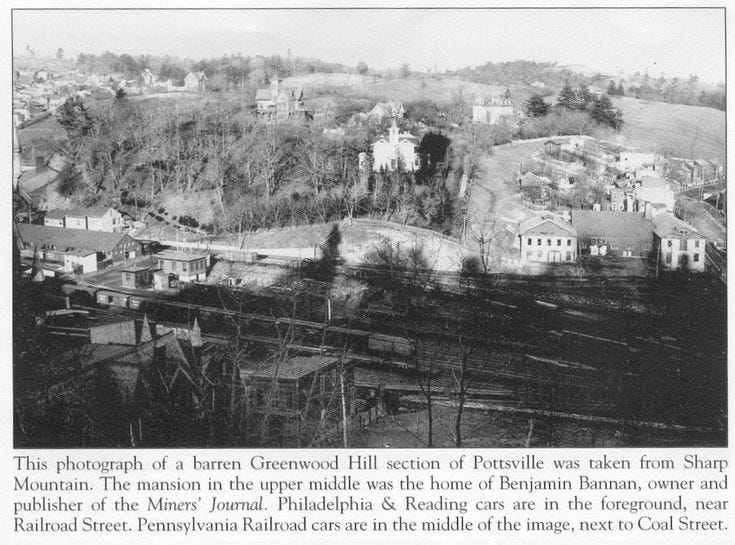
There are things we can learn from this 1950s world, when greed did not yet dominate the national scene, when neighbors talked to neighbors, when people bought what they needed in local stores and knew how to do without, when they believed in “common decency.” Too many Americans also believed in segregation, a stain on the era, and Pottsville was a de facto segregated town. I certainly had no African American neighbors on Greenwood Hill.
Yet, there was hope. The United States could become a better place.
Today, those in power seem determined to drag the country back to a time of greater racial, human, and economic injustice. In the military, African Americans and women are excluded from promotion—even when considered the best man or woman for the job—based on their race or gender. Americans, regardless of race, gender or religion, are being deprived of food and adequate medical care, of childcare and decent housing, by an administration that turns a blind eye to the “fraud and abuse” in its midst, preferring to blame the weak while celebrating obscene wealth. And History will condemn the United States for how it is treating immigrants, herding them into concentration camps (again, I refer you to Merriam Webster), a solution unworthy of our nation.
Yet, there is hope. It is rooted in each and everyone of us, and as Martin Luther King Jr.’s words remind us, “We shall overcome.”