

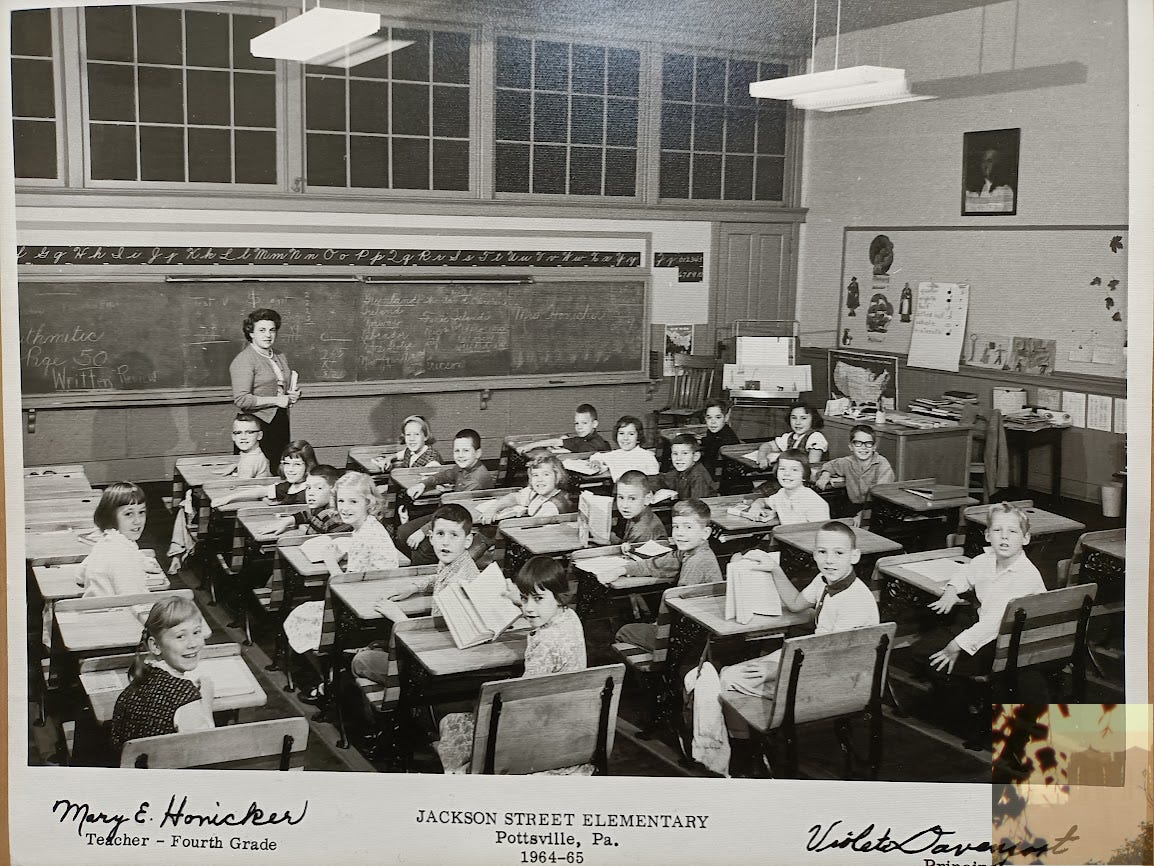
I am not bragging. It may sound that way, but such is not my intention. I am simply telling the story as I remember it. I was in second grade. I went to Jackson Street School. My teacher was Mrs. Clark. I remember the names of all my teachers in that school. I was first in reading. I had the best grades on all the tests. I loved to read, so it was not very surprising. Again and again, I came out on top.
For Mrs. Clark, this was a problem. She decided to do things differently. From now on, two people, not one, would occupy first place, a boy and a girl. I was tall. She chose a boy who was taller than me. This has nothing to do with reading, but he made me feel small. Dick and Jane and Spot, we were still reading about them in school. I’d moved on to other books at home, but First Boy had the same name as the main character in our reader.
“See Dick run.”
Our teacher let him catch up with me and then run on ahead.

My mother wanted to dress me in pink. I refused. I was catching on fast. Pink meant second place.
First Boy lived in a house on East Norwegian Street, not far from the school. It was built against the slope of Greenwood Hill, where my family lived. The house had a narrow side yard but the windows at the back looked out on a wall of sheared rock. No backyard, no front porch. The house grew up—it had three full floors—but it could not expand, hemmed in by the other tall, narrow houses on the street.
Out front, a cement stoop had to do for First Boy’s mother who, weather permitting, spent a good part of each day sitting outside. I observed her when I walked by. I don’t think I said hello. I did not play with First Boy and I’d never been invited inside his home. His mother wore shapeless shifts. She was overweight and smoked a lot. I only needed to take one look at her to know that she and her children, including First Boy, lived in a world very different from mine.
What did “different” mean to a 7-year-old girl? It’s simple. Different meant poor. And poor meant raucous and unstable.
I was a good student. Good students usually sat up front, but I was always seated at the back of the class because I was taller than most of my classmates. In that way, I got to know the “bad” students, pushed to the back so the teacher could get on with things. I remember two of them, two girls who said they were sisters, an affirmation that gave me no end of mental vexation, because they did not share the same last name.
How then, I asked myself, could they be related? In my family, we were all Honickers, and my imagination was not yet open to the idea of “blended families,” a term that surely did not exist at the time
One of these girls was strong and bold. The other, skinny and meek. They wore crinoline party dresses to school and did not have warm coats. The meek one, whose name was Bonnie, wore dresses far too big for her, with necklines so wide they sometimes slipped down one shoulder, exposing a part of her bare back, even on the coldest days of winter.
That’s how I saw it, a burn on her shoulder blade, as if someone had hit her with a hot frying pan. When she saw me staring, she yanked the collar and tried to pull it close around her neck. Too late. Sometimes my parents argued, sometimes they spanked us, but I knew that no one in our home would pick up a hot cast-iron pan to use it as a weapon.
I also knew where these two girls lived. The house looked big, empty and cold.
That year, the year First Boy usurped my place with the blessings of my teacher, at her very command, I learned that girls who win first place, who attract too much attention for their intelligence or skills, need to be pushed back and tamped down. I took note and adapted my behavior, hiding my candle under the bushel of my young body, growing taller and chubbier by the day.
I was also picking up my first notions of class, along with a troubling awareness that, rich or poor, problems spare no one. And I sensed the poor lived their poverty in different ways.
First Boy, for example, was poor in the raucous way. Like the Old Woman in the Shoe, his mother had so many children that she threw down the dishtowel, stood the mop in a corner, and planted herself on the front-door stoop. There, in a cloud of smoke, she cast off household worries, leaving her children to fend for themselves—and they did alright.
In the case of Jacqueline the Bold and Bonnie the Meek, in their home, poverty generated abuse and children were the victims. I knew Bonnie was in danger. Had I talked to my teacher, would she have listened to me?
Observing my classmates, I understood that most of them, like me, were of the middling sort. I also understood the middling sort lived on the edge. We could move up, we could move down. Poverty and violence hid in dark corners, in stairwells or cubbyholes.
Life bore out these lessons. I learned to stay in my place as a woman and lost confidence in myself. It did not help that for a few years my family walked a thin line between middle-class respectability and poverty.
I also learned that belief in progress as destiny is like believing in fairy tales.
In 1968 Richard M. Nixon was elected 37th President of the United States. Just like this year, the election took place on November 5th. Nixon defeated Hubert Humphrey, selected to be the candidate of the Democratic Party at an August convention marked by rioting and protests, held, again like this year, in Chicago, Illinois.
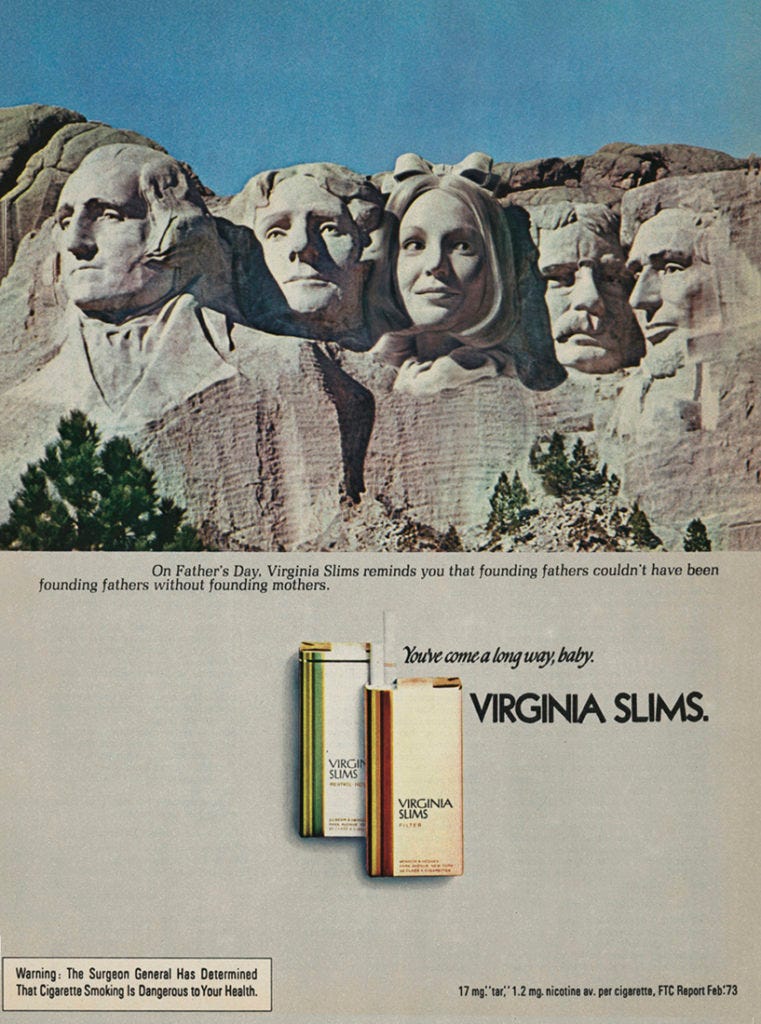
In that same year, Philip Morris launched Virginia Slims, a new brand of cigarettes marketed exclusively to women, with the catchy slogan, “You’ve come a long way, baby.” Constant progress, upward mobility, the control of one’s body—be it to smoke, take the pill, or terminate a pregnancy, were becoming women’s new reality. The sky was the limit, and no glass ceiling could resist them.
Myth number 1: Tobacco liberates women. Myth number 2: Our bodies belong to us. Myth number 3: Inevitably women will make it to the top.
Selling pipe dreams, isn’t that what’s advertising is all about?
Now I am old, but I am alive, alert, my powers of observation as keen as they’ve ever been. Yes, I’ve come a long way through hard work and suffering. It’s taken a lifetime.
Finally, I’ve grown more confident. I’ve become my own First Girl.