

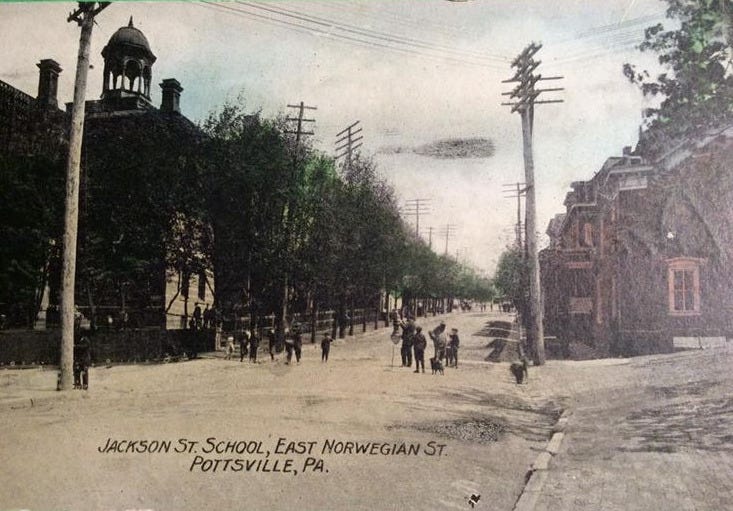
Mrs. Allen was the kindergarten teacher at Jackson Street School. It was a massive red-brick building, three full stories of classrooms, all high-ceilinged with big, high windows. Teachers had to use a special rod with a hook to open and close them.
The school was at the corner of Jackson and East Norwegian Streets, across from the Evangelical Congregational Church, where we went to Summer Bible School, and catty-corner to Mickey’s, a store and soda fountain owned by the Ambrose family, whose house occupied the remaining corner of the intersection.
Next to home, this school and this intersection were the heart of our world. After school, we climbed halfway up the Jackson-Street hill, turned left and climbed “the steps,” three flights of wooden stairs leading to Edwards Avenue. We climbed that street to its top. That’s where we lived.
Mrs. Allen became my kindergarten teacher when I first entered her classroom in 1958. On my first day, about to cross the school’s threshold, I was stopped by a boy who pushed me to the side.
“Hey, were you kept back? You’re too big for kindergarten.”
No, not kept back. Yes, tall (and chubby) for my age.
Of my teacher, I can imagine my mother and aunt saying, “Mary Allen has a tricky figure.” She was slim, well-dressed, wore tailored dresses with three-quarter sleeves and straight skirts, cinched tight at the waist. And she always wore high heels.
I liked the way she looked. Her hair was short and black. She wore it somewhere between a pixie and a bob. Her lips were always red. Surely, when we weren’t looking, she refreshed her lipstick during the day. She was an attractive woman, even-tempered and cheerful. From beginning of the schoolyear to the end, she never raised her low, raspy voice.
The voice of a smoker. I could imagine her perched on a barstool, cigarette in one hand, whiskey sour in the other. I was a child, but I knew about barrooms. Sitting at the bar, she would have turned heads.
Nothing wrong with that. I loved my teacher. She changed my life. In nursery school, a grim schoolmarm lorded it over me, putting me in the corner because my aunt had painted my fingernails red.
Mrs. Allen’s husband was called “Tubby,” and he was involved in local politics. When there were elections, that’s how his name appeared on posters: “Elect T.T. ‘Tubby’ Allen for City Controller.” Mr. and Mrs. Allen lived on West Market Street, across from Dr. Doughtery, my childhood doctor.
I went to bars when I was a child. I sat next to my father and sipped a Shirley Temple. No one paid attention to me and I got to observe what was going on. I’d already spotted Mr. and Mrs. Allen—it was her raspy voice, laughing at her husband’s jokes, which attracted my attention. For that, I liked her all the more.
Our kindergarten class had other teachers who dropped in occasionally. Mrs. Kear for music. She always arrived with her pitchpipe and blew into it to give us the first note of a new song.
Miss Gotwals taught us art, but Mrs. Allen did that too. For Halloween, she had us stuff paper bags will old newspaper, tying them shut. Then we covered them with papier mâché, let them dry, and finally, turned them into jack-o’-lanterns using orange and black poster paint. She covered one corner of the room with newspapers and there we went to paint, getting it all over the floor. This was pure joy, something I was not allowed to do at home.
Miss Gotwals taught us about color and line. She was a painter herself and I can still remember the day she showed up to decorate a big chalkboard in our kindergarten classroom.
She began with a sketch. White chalk on the green board. After sketching in the lines, she turned to us and asked what we thought she was drawing.
My hand shot up!
“A woman holding a basket of eggs!” An old-fashioned kind of woman, plump and round, wearing a long skirt.
No, I was wrong.
Other students took a guess.
No, again and again, all wrong.
Miss Gotwals went back to work, advising us to pay careful attention. Using colored chalks, she began filling in all the details. We watched, mesmerized.
She was drawing Santa Claus! There he was, dimpled and smiling, as cheerful as could be, with a sack over one shoulder and in one hand, a toy drum and a doll. She performed this feat, I believe, in every elementary classroom in the city’s eight elementary schools. Throughout my years at Jackson Street, each Christmas season, I awaited her return.
Then, on the last day of school before our Christmas holiday, we were herded into another classroom, where we had to “double up,” two students to a bench at each of the old-fashioned wood and wrought-iron desks, bolted to the waxed wooden floors. We giggled, we whispered, we waited as our principal, Mrs. Davenport, threaded a film into the school’s 16mm projector set up at the back of the room.
Mrs. Davenport asked Mrs. Allen to turn off the lights. The camera began to click and whir. A few yellowed and smudged images, then some strange symbols, then pure enchantment.
“The Spirit of Christmas” by the Mabel Beaton Marionettes.
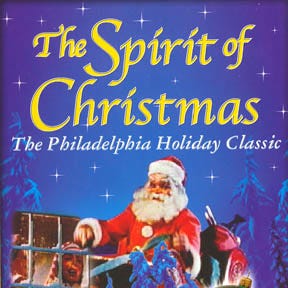
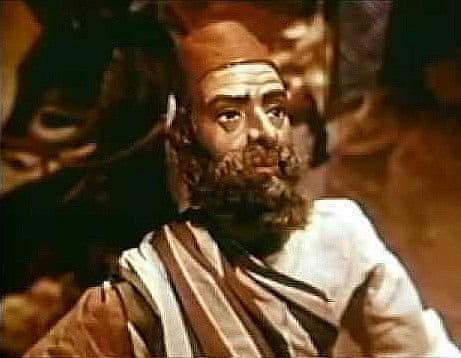
First aired on television on December 22, 1951, in the Philadelphia area, this Christmas special combined Clement C. Moore’s “A Visit from Saint Nicholas” (The Night Before Christmas) and the story of the Nativity. Mabel Beaton, a self-taught sculptor and puppeteer who, with her husband, created all her puppets and sets, decided to film these two stories, and on her first try, sold them to Bell Telephone. By the late 1950’s, the special was being shown on film in schools.
“The Spirit of Christmas” has become, deservedly, a classic (and you can watch it here: The Spirit of Christmas). Hand-made, hand-sculpted by Mabel Beaton herself, the puppets, in their expressions, through their movements, communicate emotion that goes straight to the heart. Their movements are at times halting, but at no time do they lose their grace. In certain shots, we can make out the puppets’ strings and imagine the hand working above.
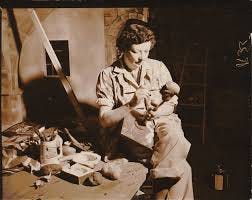
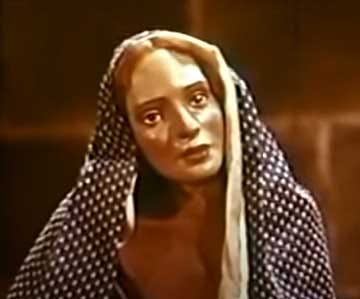
Watching the film today, I still feel the emotion and marvel at the care and skill put into bringing the puppets and sets to life. Every puppet touches us, including the animals, a tiny mouse, a dog gnawing on its bone, kittens in a basket, the donkey that carries Mary to Bethlehem. Her face and that of Joseph, though static, convey emotional force and tenderness as do the simple movements that animate them.
As for Saint Nick, he is a joy, and no computer- or AI-generated image could ever achieve the charm of Santa’s sled and reindeer, named for the first time by Clement C. Moore, as they fly away “like the down on a thistle.”
When the show was over, we sat silent for a moment. Then we applauded and talked louder than we generally dared. With the end of the film, Christmas vacation had truly begun.
And like Santa, I’ll say, “Happy Christmas to all and to all a good night,” wishing you “peace and good will” in the year to come.
Happy holidays Nancy and a healthy New Year. And by the way THANKS for all you do.🎄🥰
Wonderful memories!! Thank you, Nancy🥰 Merry Christmas to You 💕🎶