

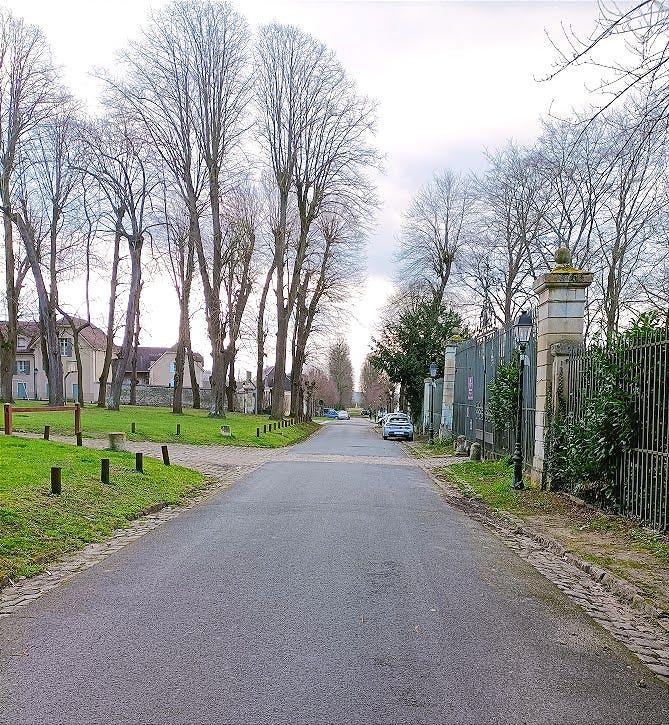
I pack my suitcase. In it I put gifts for my family. I put a pair of pajamas, underwear, an extra pair of jeans, a couple of tops. No bottles, no liquids. They go, in miniature, into my backpack.
Depending on the time of year, I put on a coat or a jacket and walk out the door, locking it behind me. My suitcase is on wheels. I drag it down a flight of stone steps, across a dirt driveway, though a high wrought-iron gate, to the street where I live. At the first corner I turn right.
From here, it’s downhill to the train station, but the going is rough, literally. The path follows the edge of a field, one year corn, one year wheat. Once it was crudely paved with tar and gravel. Now it is a random series of ruts. My feet slip on loose pebbles. The suitcase rattles down the path, which resists it all the way.
Near the bottom, almost at the intersection where I cross to the station, if there’s been rain, I lift my suitcase and tiptoe through mud, avoiding a puddle that’s as big as a pond. I’ve travelled about a half mile from my door to the train.
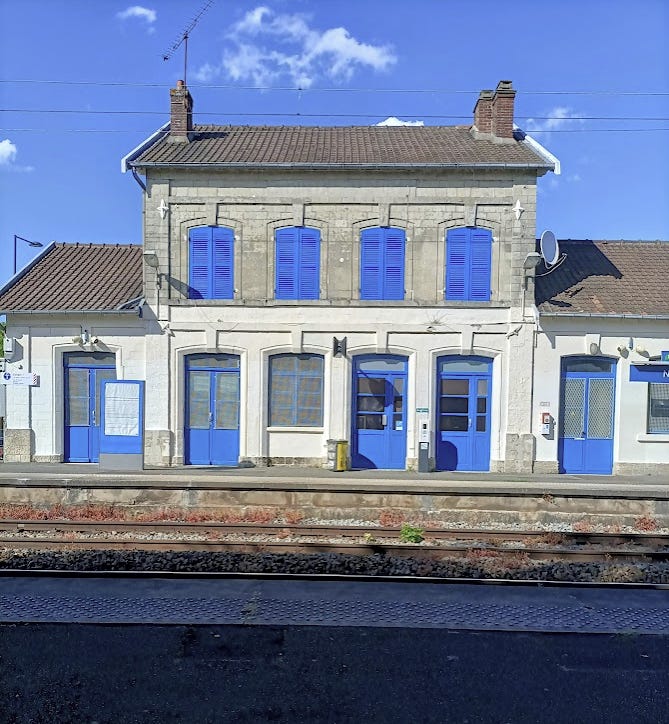
No turnstile. Instead, a kiosk that I lightly touch with my Navigo, an electronic transportation card. Others stand in line at the same kiosk to buy tickets. They are nervous. The train, on its way to Paris Gare du Nord, is approaching. When it arrives, some follow me on without a ticket. No time.
In the train, I catch my breath. I look out the window. I see forests, fields, and orchards. Every few minutes the train stops at another suburban station. Most commuters are silent. They sit and stare at their phones. The exceptions are high school students who travel in groups, laughing, shouting to each other from one end of the car to another. The girls wear false eyelashes; the boys, sweatsuits. They want to be seen and heard. They get on at one station, off at the next.
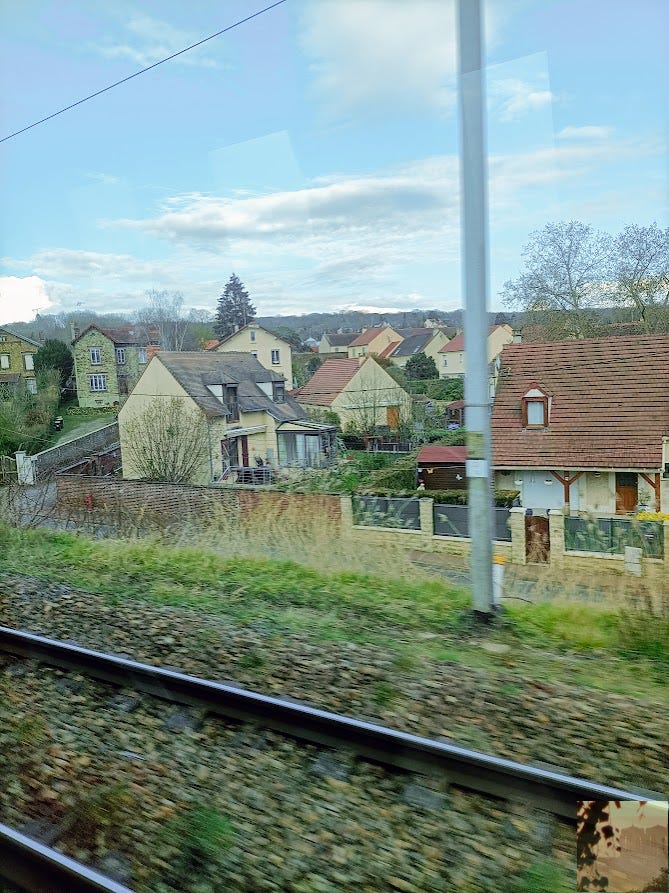
As the train makes its way to Paris, there is no clear line of demarcation between countryside and towns composed of apartment blocks and what the French call “pavillons,” small, individual homes, cinderblock covered with tannish stucco, tile roofs, a yard out back, often running to the railroad tracks.
Closer to Paris, the fields disappear, replaced by used-car lots and warehouses. In the town of Saint-Denis, the last stop before Gare du Nord, dark-skinned young men from Africa and Asia get on the train with scooters or bikes. They are travelling to work as delivery men for Deliveroo, Uber Eats or other delivery services. They subcontract with someone French and pay a percentage of their earnings to him. Otherwise, without papers, they could not hold the job. Everybody is hustling and making money off somebody else.
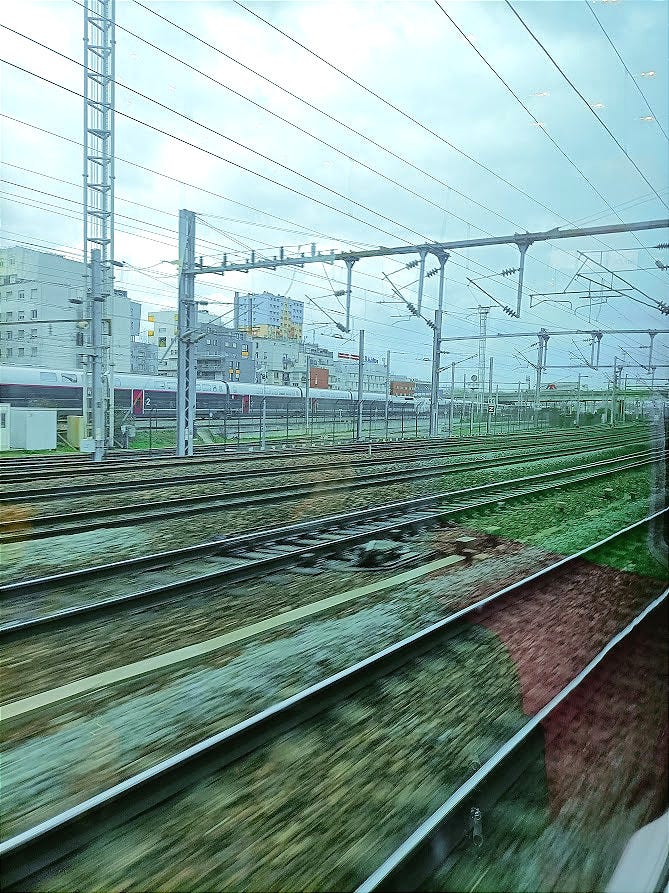
The train approaches Gare du Nord. Sacré Coeur is on the right, new office buildings on the left. As we enter the station through a corridor of high dark walls overlooking the flow of traffic in and out of Europe’s biggest train station, commuters rise and crowd around the doors.
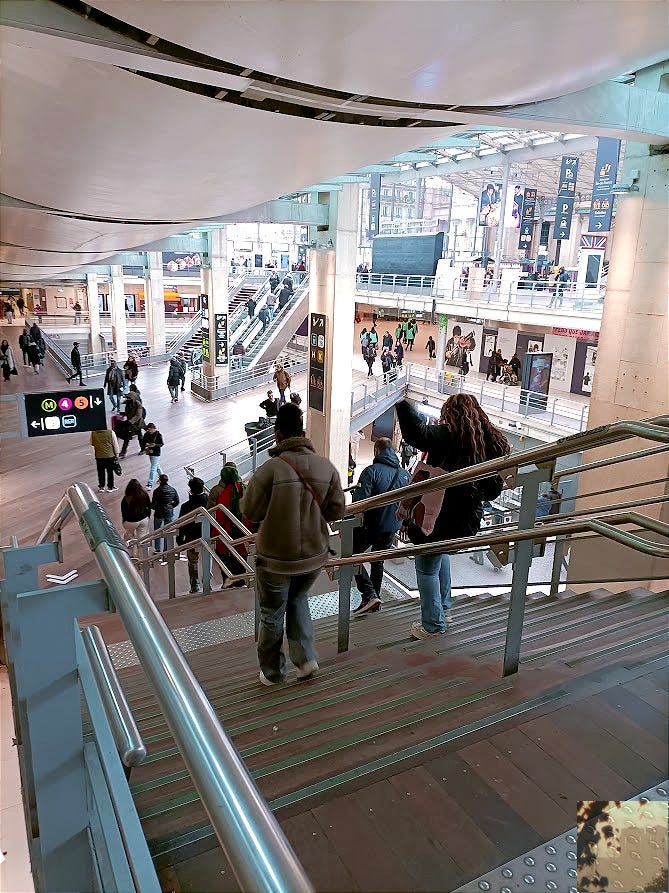
I follow them. When the train stops, I get off, take an escalator two floors deep and catch another train to the airport. At Roissy Charles de Gaulle, I submit to all the indignities of checking in and getting on a plane. Two hours later I am in the air, direction, the United States.
That’s how I go from here to there.
But how did I get here? We could all ask ourselves that question though the misfits, those who strayed from the straight and narrow, seem to be the ones who ask it most.
While still on the train, if I had asked the young men from Bangladesh, Sri Lanka, Senegal, Ivory Coast, the Congo or Mali what they were doing so far from home, they might have answered they were trying to survive, pay off debt, help their families. This is why most people go to work.
Yet, not everyone has to change countries to do so, and I’m not sure many of us have the courage these young men and many women mustered to cross deserts, mountains and seas, to face beatings, rape and death, simply to get a job.
Next to theirs, my story appears eccentric, even quaint.
I love the French language. It offered me refuge when I needed to escape my mother tongue. It is shelter, but it is not home. With French, I can travel far. It is the language that taught me how to think whereas English taught me the power of things. I love the blunt side of English, the sharp intellectual stabs of French. I love juggling them both. This balancing act has expanded my mind. I can’t imagine life without them as I walk a tightrope between two worlds.
Sometimes I fall. So far, each time, I’ve picked myself up and moved on. I have been down and out in Paris, jobless, homeless, but in a genteel kind of way. I’ve never had to miss a shower, rarely a meal. I live modestly, but my inner wealth is so much greater than that of the richest tech bros in the world. And I know I have lived with greater courage than a single one of them.
But I had to go far away to do it, and choice was only a part of it, which brings me back to travelling between here and there.
I want to banish nostalgia from my quest. In the late 18th century, when this word first found currency in English, it referred to a sickness, even a form of insanity, related to an intense desire to go back, to return home. As the novelist Thomas Wolfe wrote, “You can’t go back home…to the escapes of Time and Memory.”
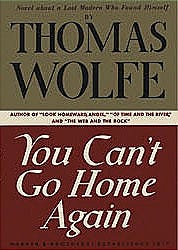
But you can go from here to there, step by step, word by word.
I can travel from the Pottsville of my youth to France. I can travel back to Pottsville, trying to take an honest look at the how and why of so much back-and forth. What happened to me along the way? What happened to Pottsville? What has happened to the United States?
How did we end up where we are today?
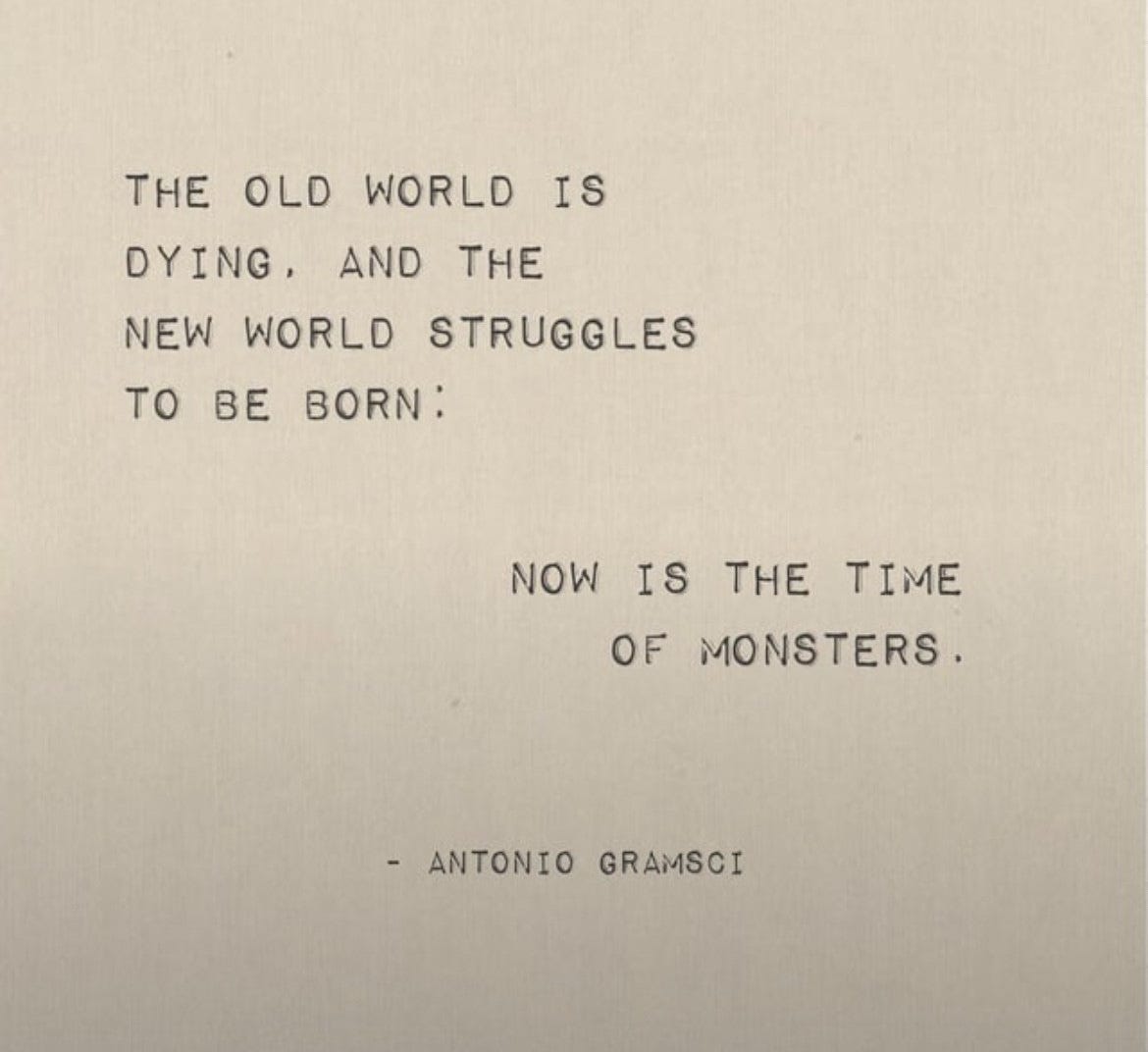
To finish, a poem by Antonio Gramsci from Dick Whyte’s “Forgotten Poets” on Substack:
Again, I loved this! So visual--specific, and yet capturing a generic "Frenchness" in each scene, and reminding me of the many train trips I took in France as well--from my place in Geneva to visit you in one of your former Paris apartments, trips from Lausanne to Orleans, others to and from Bordeaux. Again, too, the photos and physicality of the descriptions (I can feel and hear the wheels of your suitcase bumping and grinding in those ruts) perfectly capture each scene/milieu. The poem at the end was a surprise. Reminded me of Yates' "The Second Coming" (all too apropos).
I like your forthrightness Nancy. Kind of like when we are together and speaking truth to power between us.