

Toe against toe. Is that what made me sense a presence towering over me? I opened my eyes. Toe against toe. Two round-toed black leather boots so close they almost overlapped the tips of my cheap synthetic slippers—ballerines, the French call them, shoes too flimsy to carry me through a day begun before dawn, that would continue well after nightfall.
I’d been dozing. At eight o’clock that morning, I began my workday teaching in a private school a few steps from the Champs Elysées. When you arrive in a new city without a job, you take what you can get. I’d picked up a few hours in that school, but not enough to make me full-time. I’d picked up one class in a suburban university, a drop in the bucket, night classes in a language school in Paris. Like a miner, I spent my weekdays in the dark, in the underground labyrinth of the metro, moving between jobs. Only on weekends could I enjoy sunrise or sunset.
All that running around, all that work, and I could hardly pay the rent. I was sharing an apartment with a colleague I had met while teaching at the Lycée français de New York, a French high school that loved hiring Americans like me, fluent in French, for a lower salary than they paid teachers recruited in France. Still, I liked it there, liked my French colleagues. They offered me a glimpse of a different way of life, more culture, more leisure, more vacations, family homes in idyllic spots. I wanted to have that too, so I uprooted myself from New York City and moved to France.
A long story, a very long story, with many detours and side trips. I even did a stint at a university in Poland. There I was paid in zlotys, making the equivalent of one hundred dollars a month. The clerk counted out the bills, a thick wad adding up to more than a million in the local currency. Then I signed a ledger, next to my printed name, with a pen that, point-down, set in motion the Virgin Mary rising to the sky on Assumption Day.
By the time I arrived in Paris, I’d been through an unhappy love affair—in an appropriately idyllic spot, a house in the hills above Nice overlooking the Mediterranean Sea. I’d also been through a year in Poland just when Communism and the local economy were crumbling. Life was hard.
While still in Poland, I received a letter from my former colleague, proposing we share an apartment in Paris. It sounded perfect. I said yes. When I returned to the city in June, I got busy seeking work. In Poland, I paid no rent (that’s how I survived on one hundred dollars a month). In the South of France, the rent we paid was ridiculously low.
In Paris, I had my work cut out for me: a hefty rent, utilities, shared grocery bills. It left me broke.
I am a person of duty and honor. I do what I must to pay my bills. I honor my debts and my word is worth its weight in gold. That’s how our mother raised us. Principles like that don’t always carry you far in this dog-eat-dog world.
My apartment-mate, who worked far fewer hours than me, did the food shopping and then presented me with my half of the tab. She ate most of her meals at home and did not shop with me in mind. I spent my days on the road. After paying all the bills, I had nothing left for food. I could not afford a sandwich from a bakery, a crepe from a street vendor, not even a paper cone filled with roasted chestnuts.
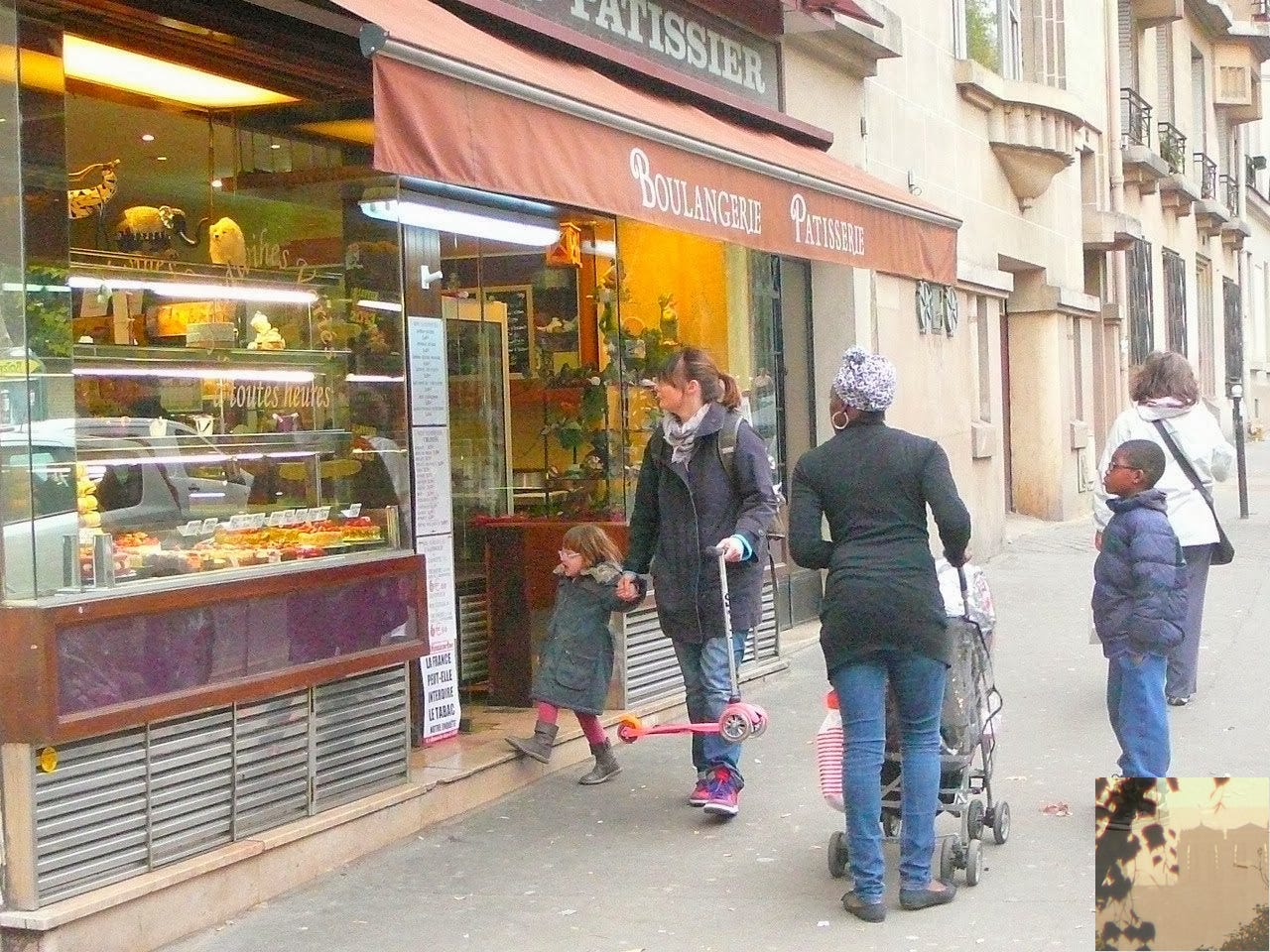
Like Sarah Crewe in The Little Princess, I pressed my face against the windows of bakeries and admired all I could not afford. Then I rummaged in my purse for a couple of francs (this was before the change to euros in 2002), pushed open the door of a bakery, and bought myself a petit pain, a crusty roll, breaking off pieces, chewing slowly, making it last.
That day, half a petit pain nestled on my lap. I’d been eating when I dozed off. I was on a suburban train between Paris and the university where I taught once a week. I was late. I usually didn’t take this train, much faster than the metro, because my transport pass did not include it. I took a risk and lost.
Those black-booted toes so close to mine? They belonged to the ticket collector. Apparently, he’d been trying to wake me up. People were looking at me, slumped on the seat, sleeping as soundly as a bum. The ticket collector wanted to see my ticket. I didn’t have one.
Pay the fine on the spot or it would double. One hundred francs. Usually I didn’t have that much money on me, but that day, it was there, in my wallet. I’d been planning to pay my share of the groceries that evening.
Instead, I used most of it to pay the fine.
When I got off the train, I still had to wait for a bus to the university. Then I had to teach a three-hour class in front of fifty students. All I wanted to do was sit on the curb and cry.
But I didn’t. I did my duty. Taught. Went back to Paris on the metro. Taught some more at the language school. Went home. Told my friend I could not pay all I owed. She got angry. I went to bed. In a few hours I’d be starting all over again.
Am I recounting a tale of woe? No, I am not. Am I vaunting my survival skills? Not that either. No, I am telling what the French might call a story of “immigration light.”
Jokingly, I used to call myself “une immigrée de luxe,” a high-end immigrant. I’d never had to cross a desert on foot, never had to deal with coyotes at the border, never been raped or beaten, never worked in a sweatshop. The exploitation I did experience on the job was negligible, and most immigrants or refugees would have gladly exchanged places with me.
Our immigrant ancestors in the coal region would have felt the same. A roof over my head, a warm bed, enough food (though not always when I needed it), clothes on my back, shoes on my feet. What more could I ask?
I arrived in Paris in June 1991. In June 1999 I was awarded tenure in the French national university system. Quite an accomplishment for an immigrant.
And here is what I learned along the way: Immigrants try harder, work harder, give more of themselves on the job because basically they have no choice. And they give much more than they take. When it comes to decency, integrity, the old-fashioned American work ethic, if I had to choose between a tech bro billionaire and an immigrant, hands down, I’d take the immigrant any day.
France took me and I paid my dues, like immigrants everywhere.
My Eastern European grand- and great-grandparents worked hard to pave the way for life that I have today. I am eternally grateful to them. This is a wonderful article about the perseverance of those, including you, who have grit and growth-mindset. Thank you.
Thank you for sharing this, Nancy. We’re all immigrants. That’s what frustrates me when I hear people complaining about immigration, legal or not. Sigh.
I really like how you made this personal as well as offering a connection to coal mining.