

Why should it be different here than there? In Paris, Pottsville, or le Perche, the region of gentle hills, orchards and oak forests I inhabited for a while? Human nature does not change. It is the same everywhere, and we cannot transcend it on our own.
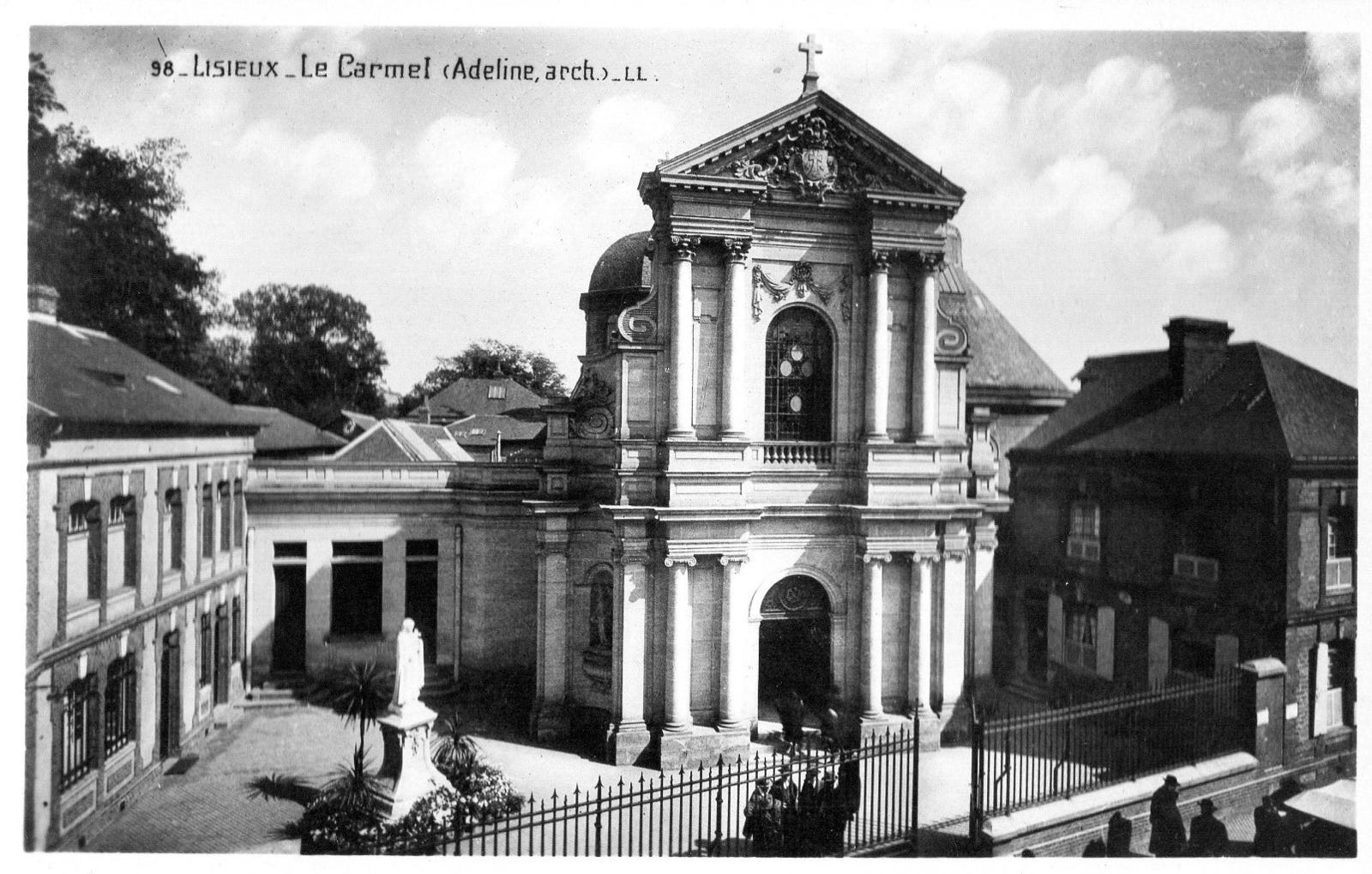
Today I am in Normandy, a few miles from the Carmel where Saint Teresa of Lisieux declared that without the help of Jesus, she was incapable of loving her neighbor as herself. His presence in the fleshy tables of the heart, to borrow a phrase from the Apostle Paul, dissolves rejection and repugnance, transforming them into love. I repeat, the saint claimed she could not do it on her own.
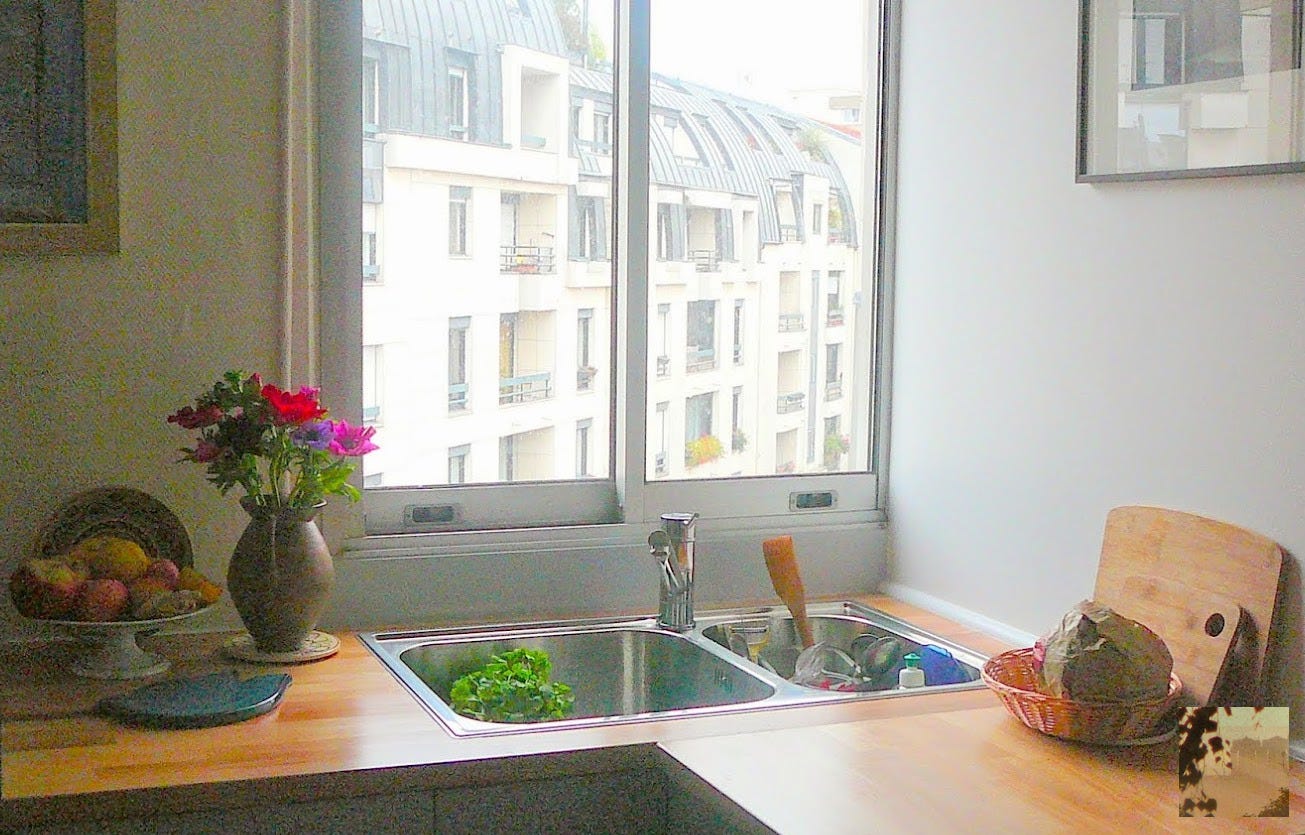
In my Parisian apartment, my little eagle’s nest seven flights up, a perfect lookout over the roofs of Paris, a watchtower that made of me a sentinel, I watched and listened. A city reveals itself as much by sound as sight. And, of course, in a city like Paris, where at any hour of the day or night, fresh bread is baking somewhere, by smell.
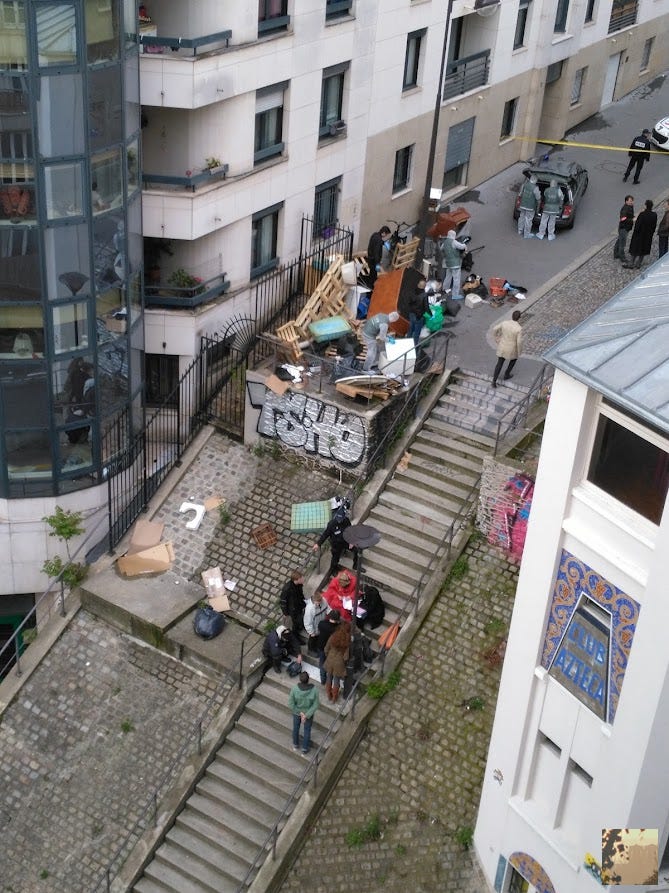
From my kitchen window, I looked out on a public stairway. I got to know the people who went up and down. I watched a father and daughter from the days when she held his hand and he patiently waited as, placing two feet on each step, she descended slowly and triumphantly. The stairway was tall and steep. Her father’s patience and his steady grip, step by step, day by day, built her confidence.
She grew up, let go of his hand. Then she went down the steps alone or with friends. Sometimes they broke into a run. They heard their bus coming down the hill. They plunged downwards and hopped on at the stop at the bottom of the stairs.
I was seven flights up but the busses made my floorboards tremble. When, around 5 AM, the first metro of the day rumbled underground, I felt its vibrations in bed. In summer, when the bedroom window was open, I heard voices all night long, those of revelers who’d missed the last metro, of the homeless locked in desperate arguments, of a solitary man serenading the moon.
I heard my neighbors too. On the top-floor landing there were the doors to three apartments. Mine was in the middle. To my right, lived a group of men. They were from Mali and they’d turned the apartment into a dormitory where, at all hours, someone was sleeping in a bunkbed, someone else, eating in the kitchen or showering or washing clothes. I know. I heard.
I saw them too. One man was the chief. He spoke French well, took care of business and made sure his frères (his brothers, not in blood, but in culture and religion) never made too much noise.
In many buildings, such a living situation was not tolerated. Some feared marchands de sommeil, slumlords who rented, not apartments, but pallets, a place to sleep, like beds in a flophouse in the Bowery at the beginning of the 20th century. Others feared such a presence would harm the “standing” (an English word enthusiastically adopted by the French) of the building and bring real estate values down. Un immeuble de standing, an upscale building, isn’t that where everybody aspires to live?
I had power over these men. I was president of the co-op board. One word from me and it was all over. But I liked them. We made good neighbors in a motley kind of way. Only during Ramadan did things sometimes get too boisterous. For iftar, the evening meal that marks the end of the daily fast, more men came over. They ate and celebrated together, and as an Algerian friend explained, they think they’re under the stars. Or wished they were, with families in their village back home.
When the “chief” went home to Mali (all his papers were in order, contrary to the others), he always brought me back a gift, a trinket, a necklace, to thank me for writing letters for him in French. He never invited me inside. Haram! Forbidden, a woman among all those men.

I think back fondly to that time. Everywhere in Paris, living stacked on top of each other, we had to learn to get along with neighbors simply to survive. Together with the other people in my building, I formed a loose community. I didn’t like them all, but I knew we were in it together, and I discovered something, if not to like, to appreciate in everyone.
I also found a true friend, though things did not start out that way. Before I saw him, I heard him and the first time we spoke, I scolded him like the schoolmarm I was.
Thierry lived directly below me. He liked to go out and leave his stereo on full blast. No one was home, no person, that is. The music was for his cat and dog. It took me some time to figure this out. For weeks, I’d been going downstairs, pounding on the door, and getting no answer. Not even a bark from the dog.
Then, one day, while the music blasted, I heard somebody on the landing below. I rushed out. Thierry, letting himself in after having stepped out for a baguette. Leaning over the banister, I gave him a tongue-lashing.
Instead of tongue-lashing me back, he invited me down for tea and tried to kiss me on the lips (this is not the French way, but it is Thierry’s. When I got to know him better, I saw him try to do the same thing with his downstairs neighbor, a pretty dentist from Columbia).
That’s how it all began, twenty years of a beautiful friendship and hundreds of glasses of strong, sweet gunpowder tea, made the way Thierry learned to do it when he served in the French army in Chad.

On summer evenings, we often went out for a beer. Sitting at a café, we talked about ourselves and our neighbors. During these conversations, I played the straight man, remaining unperturbed by Thierry’s énormités, statements that would have made many a schoolmarm blush, even jump up and run away, deeply offended in her pruderie. I’ll give you an example but I won’t translate. I’ll leave that up to you.
Le voisin, il se masturbe tous les matins.
Ah bon? Comment tu le sais?
Ben, je l’entends. Quand je suis dans la salle de bain. Il se douche en se masturbant.
Et tu l’entends?
Ouais! Tu ne me crois pas?
Si, si, je te crois mais…
Mais quoi! Il lui faut une meuf.
When the neighbor finally got “une meuf,” I was happy for him and asked Thierry if things had changed.
Bah, ouais! C’est terminé.
Inside our building, we had our little clique, Thierry, the only man, and three other women. When Aperol Spritzes became all the rage, we gathered in my apartment for drinks, sitting on cushions on the floor, sharing homemade savory treats.
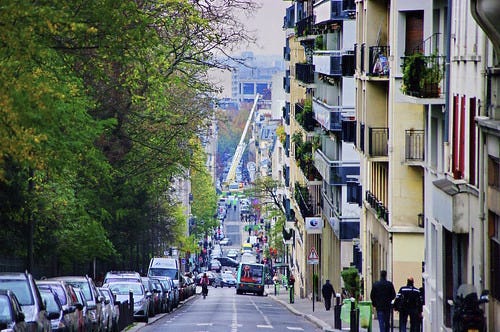
Surely, I am idealizing what I have lost. My street was noisy, polluted and steep. I spent my life climbing hills and stairs. It even got to the point where, to avoid the seven flights between me and the street, I did without my daily baguette. Recently, I injured my knee. If I had still been in my eagle’s nest, there’s a chance I would have starved to death!
But back in those days, I loved my neighbors and didn’t even have to try.
Paris is a small city, its limits marked by a beltway formed by what were once fortress walls. The expression Paris intra-muros, Paris within the walls, is still used to distinguish the city from its suburbs.
Only once I stepped outside the walls, did the commandment “Love thy neighbor” become a challenge too big for me. Why? That’s what I’m still trying to figure out.