
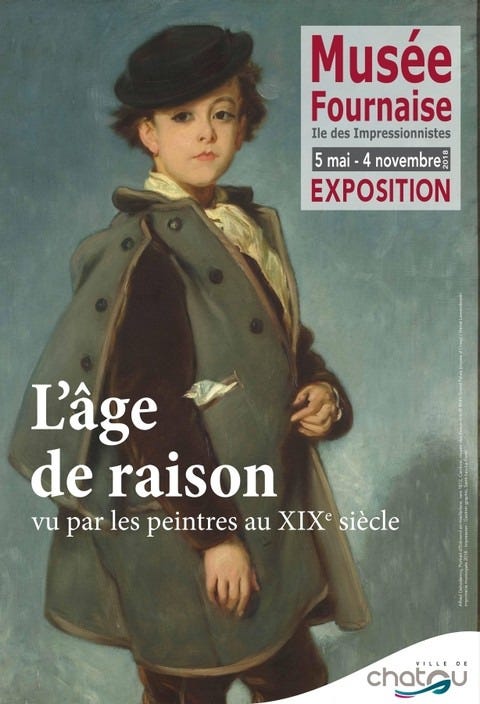
I keep returning to that period, what the French call “l’âge de raison.” I was 7 years old. Things were changing. Was it the world around me, or was something changing inside? I saw things I’d never seen before. Injustice, good and evil, my first inkling that life was not fair.
I was at the Acme with my mother. In those days, on what we called “the boulevard,” were Pottsville’s two biggest supermarkets. The A&P was at the corner of East Norwegian Street; the Acme, on East Arch. My mother shopped at both. That day, she gave me a penny to put in the slot of the bubblegum machine, posted at the exit. While the checker added up her groceries, punching in the prices on the cash register, I ran to buy my sugar-coated, bright-colored ball (hoping for blue!) of bubblegum.
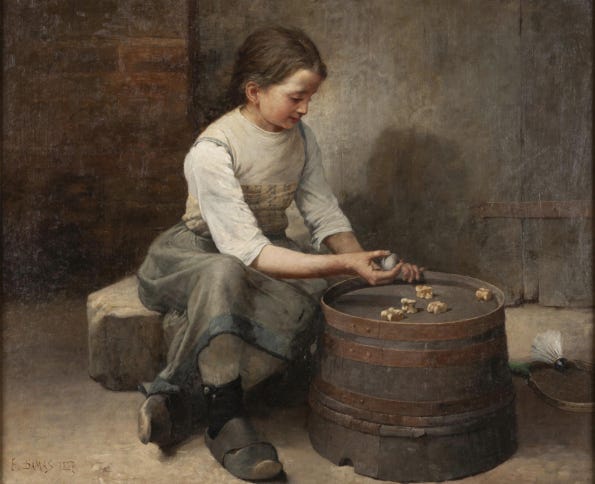
At the gum machine stood another girl. I knew her. She was in my class, but she was not my friend. I did not sit near her and I did not want to know her. She was unkempt, even dirty. Her clothes looked like she’d slept in them.
When she saw me, she said one word: “Here.” She was offering me a ball of blue bubblegum!
What do you do when chance gives you exactly what you were wishing for?
You open the palm of your hand and take it.
We stood facing each other. She no longer had her bubblegum. It lay in my hand. It was sticky. She’d held it tight in her palm before she’d let it drop into mine.
I mumbled thanks. I felt confused. At school, we did not speak. Still today, it’s hard for me to sort through the mix of feelings that rushed through my mind.
The ball of gum stuck to my palm and stained it blue. Maybe it was dirty. Should I put it in my mouth?
Was she offering me her friendship? Didn’t she know that girls like us could not be friends? I was a good student, a Sunday School girl. My clothes were washed and ironed, always clean. I was friends with girls and boys like me.
Other things too.
My mother took us to Sunday School every Sunday, dropping us out front of church. My teacher was Mrs. Wilkins. She made us feel we were not worthy of God. Surely we’d have to do better before he answered our prayers.
Doing better, I was good at that. I’d already learned to take up challenges. Doing better meant obeying my elders, working hard at school, and being charitable to those less fortunate than me.
The girl from my class offering me her bubblegum was less fortunate than me. She was, to use a language I did not possess at the time, an object of my charity.
Except that she’d turned the tables on me. She was giving. I was receiving. This was not the way it was supposed to be.
In one hand I held the bubble gum. In the other, I still had my penny. That’s it! I could pay her for the gum. A commercial transaction would set things right again.
Besides going to Sunday School, every Monday I went to Good News Club, a weekly meeting to evangelize children. I began going because other kids in the neighborhood went. We walked there together after school, to the home of our teacher on a promontory overlooking the boulevard and the train tracks leading to Pottsville’s passenger station, soon to be torn down.
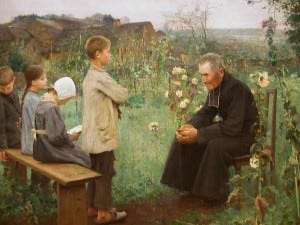
At first I went because the other kids went. Then I went because, at the end of class, our teacher gave us a cookie. Little by little I fell in love with my teacher and that’s what kept me going back. Her name was Mrs. Lawrence and she remains one of the kindest women I’ve ever met.
Now Mrs. Wilkins and Mrs. Lawrence stood next to me at the bubblegum machine.
Mrs. Wilkins, girdled by the armor of God, pressed an open Bible to her breast. Her eyes were raised to the heavens. She was in direct communication with the Lord, who knows how to recognize his own. “It is more blessed to give than to receive,” I heard him whisper in her ear.
But should I give my penny?
Mrs. Lawrence did not wear the armor of God. If I pressed myself against her when she handed me my cookie, she was as soft and comforting as a feather bed. Yet now she just looked at us, saying, doing nothing. She was of no help at all.
It is easier for me to give than to receive. I am good at choosing gifts in keeping with the tastes and character of family and friends. I love to observe people, their unconscious ticks, their spontaneous acts, their habits, what makes them who they are. I talk too much. I like to turn life into story, but I never lose sight of the person I’m talking to, the desires, the needs.
Common knowledge tells us it is better to give than to receive. I am not so sure. Receiving, truly opening our hands and heart to another, is a naked confession of need. When face to face with a cheerful giver, one like Georgine, the girl who offered me her blue ball of gum, who gave her all, I retreat behind my armor, ashamed of what is basic to each and everyone of us: I need you. I need love. I need family and friends.
When I was seven, I didn’t know much about giving, but I knew something about germs. We washed our hands when we got home from school, before meals, at bedtime before we brushed our teeth. With the soapsuds and the dirty water, the germs swirled down the drain.
Georgine was dirty. She lived in a house that had once been grand. Her family had turned it into a dump, the yard piled with rusty metal and discarded furniture. They burned their refuse in a pit and I wondered why. Georgine’s uncle, who lived in the same house, was a garbage man who jumped on and off the truck, tossing trash and ashes into its bin with acrobatic ease.
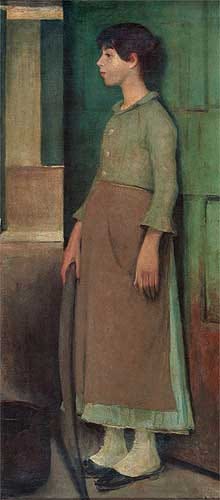
Give her the penny and owe her nothing.
“Only the wicked do not repay,” Mrs. Wilkins righteously observed.
Mrs. Lawrence still did not speak. She was staring at Georgine, guiding my gaze in her direction.
Our eyes met. I saw another girl like me. I raised my hand to my mouth, popped in the gum and chewed. My tongue and teeth turned blue. Georgine smiled and I smiled back.
My mother, pushing her cart towards the exit, broke the spell. Still chewing, I followed her out of the store to the car, the penny she gave me clutched in my hand.
Georgine stayed behind, a sentinel next to the gumball machine, a waif, a messenger. We did not become friends, yet she is a part of me, the cheerful giver who exposed my need.
Such a wonderful memory of the blossoming, universal, awareness of the relative stations in life of our childhood peers - starting with home culture and financial resources. Meanwhile, every one of your admiring readers is drawn back to their own moments of awareness. Thank you for this beautifully written and relatable tale!
Made me dig a bit. I just read that sociologists say this awareness begins to really fire up around age 10 or 11 and it's called "social reasoning development." We begin to form a matrix of intergroup judgements and comparisons. Apparently it's a bit of a stormy period as the child develops a deeper awareness of unfairness. Well-beyond the "hey, his slice of cake is bigger than mine."
How we all deal with this over our lifetimes is a fascinating thing. Well into my twenties, I was acutely aware of suffering in the world. The beginning of it was being urged as a child in the cafeteria at St Patrick's Day School at 7th and Howard Ave (now the Assumption BVM School) to finish the wholesome cafeteria lunch served up by the cafeteria ladies (remember them?) because there were children in China who "do not have enough to eat". A sensitive child could become very glum - who are these children and why don't they have enough to eat. After-lunch recess in the schoolyard ruined.
I also had a classroom mate who had survived a bout of polio, marked by his body brace (I still remember his name), and whose family did not have the means to keep him groomed and washed. He was ostracized and sat alone, though the sisters somewhat protected him and went after the bullies instead.
I grew up thinking that these things were surely front-of-mind for everyone, failing to understand that everyone is just too busy keeping their own lives on the tracks - kids, homework, sports teams, meals on the table and in the lunchboxes, dads getting out to work. and tending the chores on the weekend. But it was the idyllic fifties and sixties. We could go to the moon, we could fix these thing. I did door-to-door fundraising for a variety of causes - I was good at it.
Fast forward to my late twenties when I first heard or had the capacity to understand the concept of "personal efficacy", essentially your own ability to effect change in the world around us. It was very eye-opening to realize that I had zero efficacy to change a single one of the many global forces that result in unfairness, though I could engage in kindnesses in my own sphere of influence and feel I was doing my small bit. Freeing.
Today, the awareness of unfairness lingers but I think I've completed my social reasoning development. I do still hate bullies.