
Scratching the Surface
The anthracite region of northeastern Pennsylvania as a powerful metaphor for life.

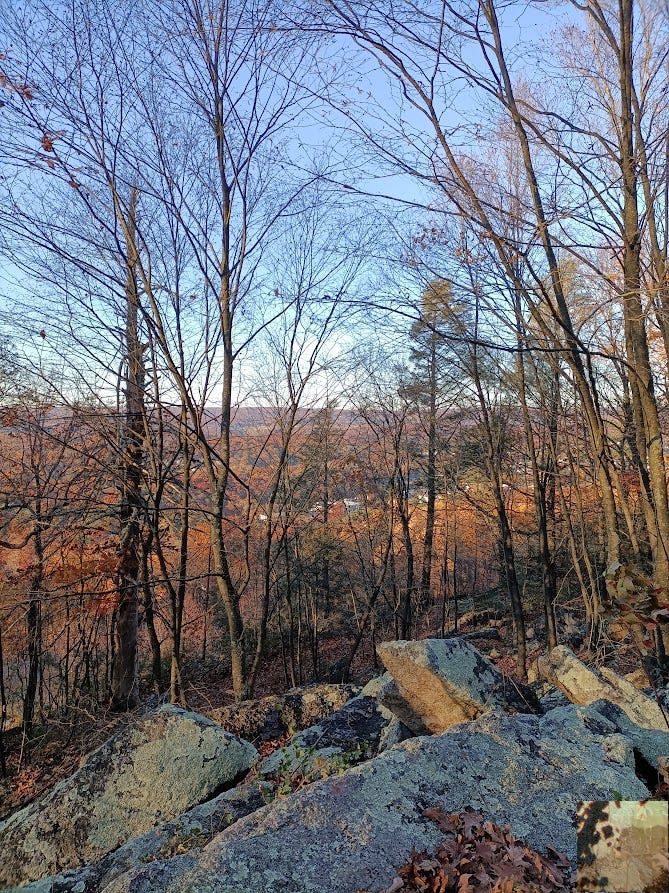
I live in a beautiful place, but I’m not sure I like it. It’s not just the plumbing problems I wrote about last week. Besides decades of stagnating sewage, the building also sits atop a labyrinth of underground springs. On one hand, this is a boon: we use the water that gurgles up from beneath the earth into the building’s cellar to water the grounds, a great savings. Yet, these springs have caused the foundations to shift, and the entire building, from top to bottom, is permeated with damp.
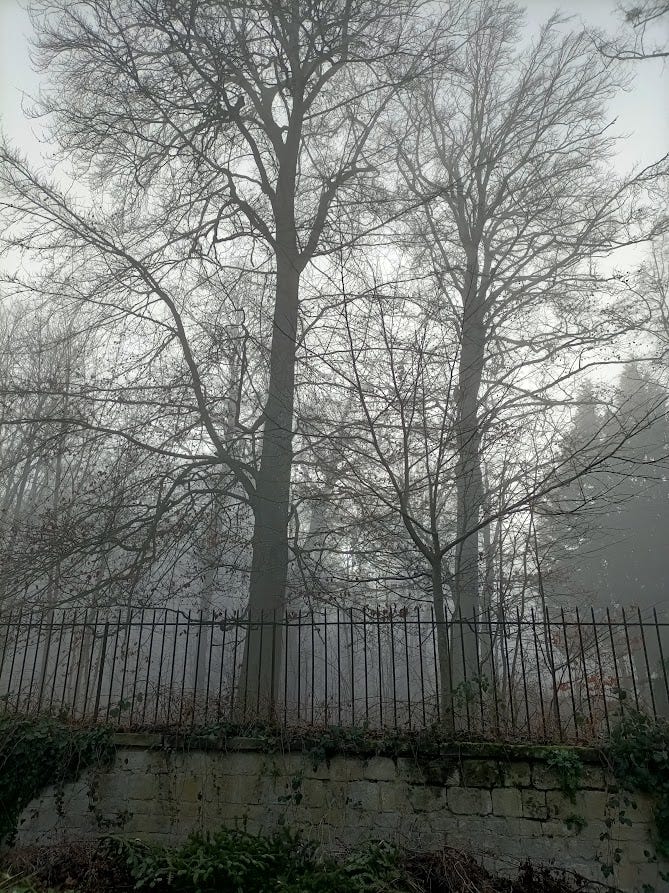
On the coldest days of winter, I huddle close to the fire, my computer sitting on what we used to call a TV-table. A strange tableau vivant, a gray-haired lady with a shawl wrapped around her shoulders, her fingers flying over the keyboard of her ultra-slim laptop.
You would think, growing up in the coal region, I’d be more attentive to the ground beneath my feet. Since childhood, I’ve been watching it slip away, and early on I learned that what lies beneath the earth is just as important as what its surface reveals to us. I was not yet six years old when I had my first lesson.
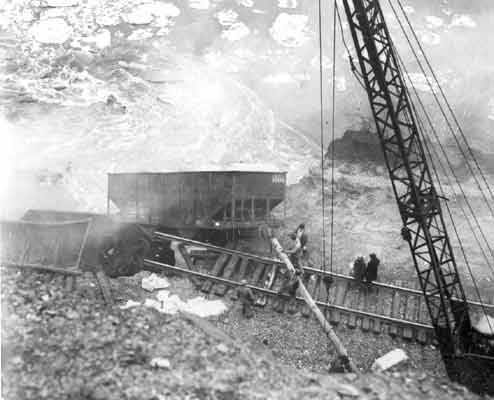
In January 1959, my father and I drove to the scene of the Knox Mine Disaster in Port Griffith, PA. We could not get close. Police had cordoned off the banks of the Susquehanna and the river water churned like a maelstrom. Beneath the river ran a mine tunnel where, on January 22, 1959, miners had been working with only six to eight feet of roof-cover above their heads (50 feet was considered the norm). The roof broke, the waters of the Susquehanna flooded the tunnel, killing twelve of the eighty-one men working in the mine. There could have been many more deaths, but Amedeo Pancotti, one of the survivors, saved the lives of thirty-three men, including his own.
In the aftermath, seven people, including the owners of the Knox Mine and the president of District I of the UMW, were indicted for manslaughter, but the convictions were reversed on appeal. The widows of the miners who died waited more than four years to receive death benefits.
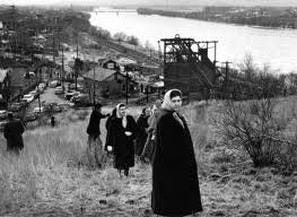
Standing with my father on a hill overlooking the site of the accident, I am cold. The ground is damp, the river below is angry, destructive and wild. The day is foggy, a pall pressing down on us all, even on a five-year-old girl, conscious she is witnessing the sacrifice of human life to greed.
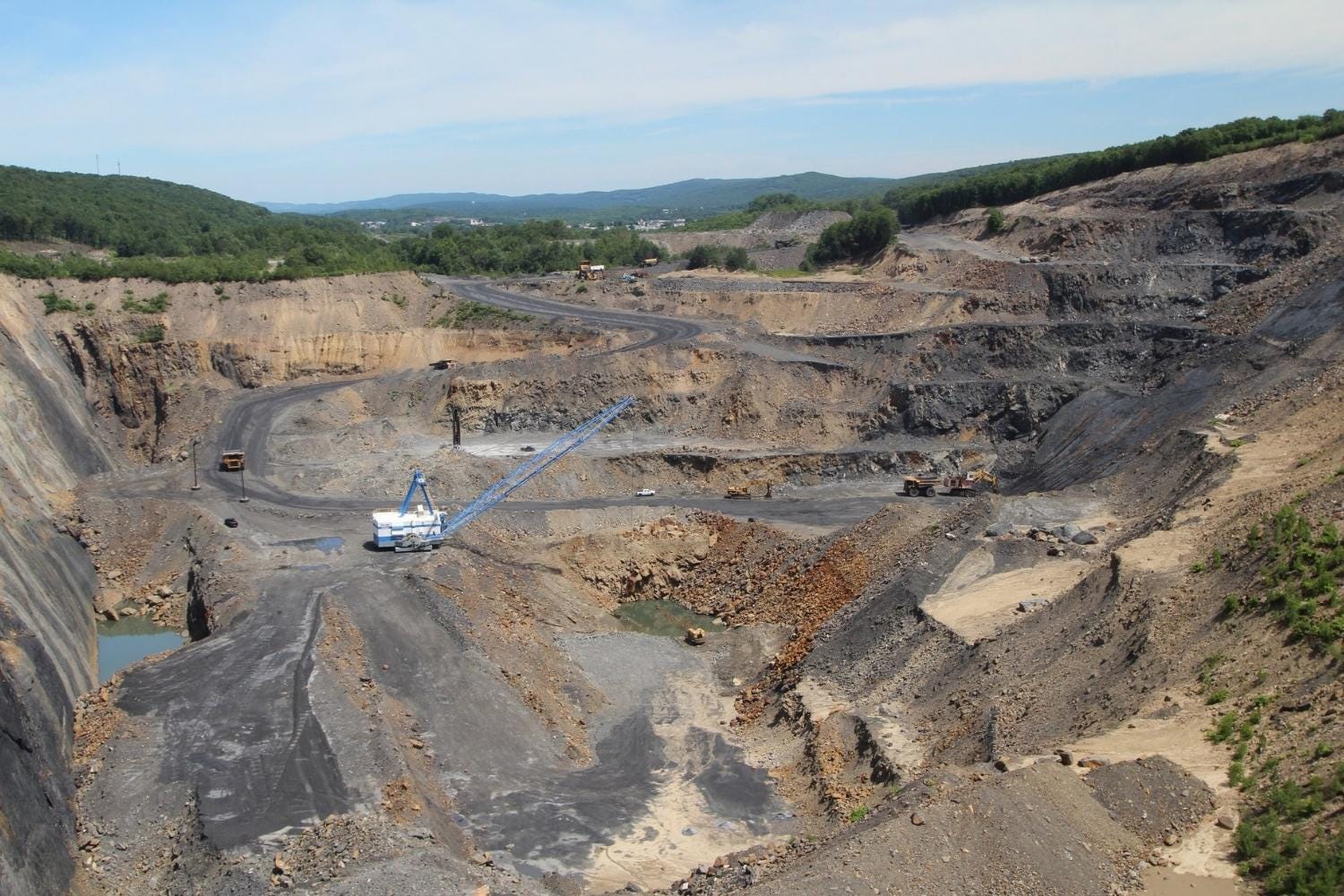
My father also took me to visit surface mines north of Pottsville. It was the early 1960’s, a boom time for stripping operations. After the Knox Mine disaster, underground mining, already in decline, came to a near halt. It was more profitable to simply rip the surface off the earth.
My father and I, standing at the edge of a pit, watched a giant power shovel dig into its face, excavating buckets of multi-colored rubble. It sure didn’t look like coal to me, not the kind we stored in our coalbin, shiny and black. The shovel was far below, we were out of its reach, but it still frightened me. Did my father tell me (because sometimes he did things like that) or did I imagine that at night, the power shovel lumbered up out of the pit and roamed into town, all the way to the bedroom windows of little girls huddled in their beds? I believed that. The shovel made me afraid.
And if that weren’t enough, Centralia, at the border of Columbia and Schuylkill Counties, was already on fire. In the early 1960’s, my father worked in State College, PA. He commuted and returned home on weekends. Sometimes he took me along. We drove from Pottsville to Ashland, from Ashland to Centralia, then to Mount Carmel, crossing the Susquehanna River at Sunbury and then, after Lewisburg, following country roads.
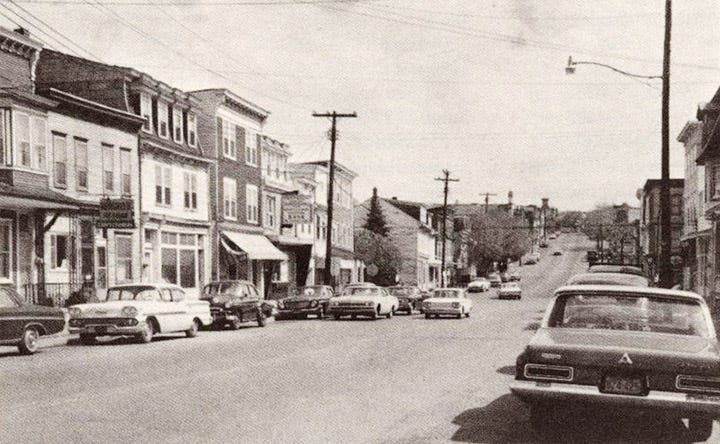
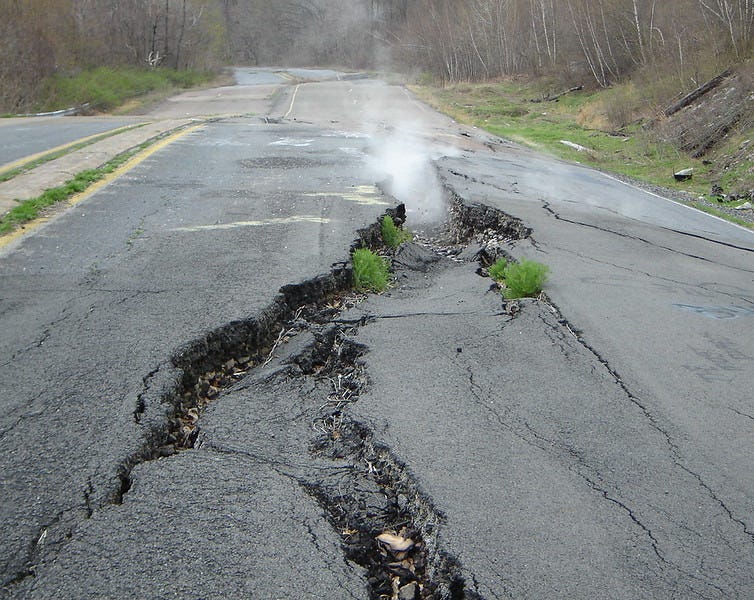
Already in 1962, mine fires were burning beneath Centralia when my father and I drove through town—though inhabitants were not yet considering leaving home. Later came the subsidence and the toxic gasses; the will-o-the-wisps, tendrils of smoke, rising from the ground; the earth glowing red at night.
In the 1990’s, you could still drive from Ashland to Centralia on Route 61—despite the visible cracks in the road. I drove there with my mother and a dear friend I’d met in France. We went to the Odd Fellows Cemetery at the crest of the Route 61 hill. It was spooky and sad to watch smoke rising from the graves as if the souls of the dead were fleeing too. Today the fires still burn, the worst coal-seam fire in the United States.
Closer to home, from my bedroom window on Third Avenue in Pottsville, I could see the western end of Sharp Mountain. In 1984, an SUV fell through a sinkhole on its northern slope, visible from my window. Back in those days, the mountain was crisscrossed with dirt roads, and cars travelled them, despite the danger, to get to a big clearing with a firepit, a rallying point for students, high-school and older, who gathered for beer parties. A car was necessary to transport a keg to the top.
On Saturday, April 28, 1984, six young people left home for a picnic but never returned. On April 30, Robert Shultz of Llewellyn spotted the back wheels of a Chevy Blazer about seventy-six feet down a 319-foot deep mineshaft on Sharp Mountain. Rescue efforts began immediately, but it was impossible for rescuers to descend into the shaft by rope. They too risked losing their lives. First, one hundred feet of metal pipe had to be welded together to make descent possible. The young people were found, but all six were dead.
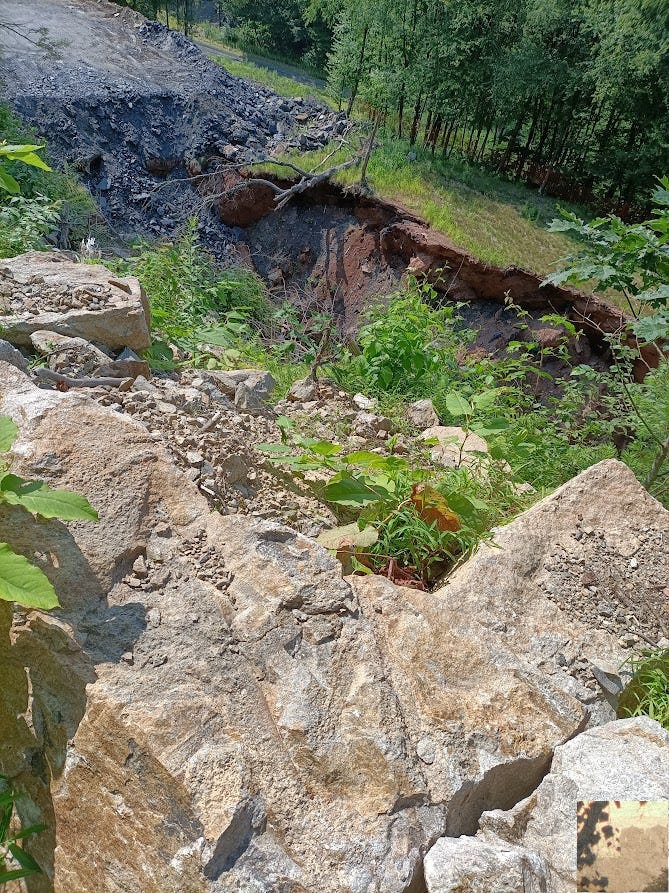
Since that time, subsidence on Sharp Mountain has continued, only getting worse in some spots. We still walk there anyway.
Perhaps that’s my problem. I’m used to living on unstable ground. Growing up on Third Avenue, my sisters and I often played in the woods behind our house, skirting sink holes, climbing culm banks, walking the railroad tracks that were torn up years ago to make way for the Pottsville bike path. We liked the softness of the peaty earth. Walking on it, we felt like the Lenapes who once inhabited this land. The streams, though, ran orange, and beneath our feet were the galleries of the abandoned York Farm Mine and Colliery.
Was there a chance that we too could have been sucked down into the bowels of the earth? Yes, I think there was.
Not so far from where we lived, on July 23, 1892, a giant gas explosion rocked the York Farm Mine. A miner, L. Llewellyn, smelled the gas and following colliery rules, went to inform the fire boss. Too late. Another miner, Christian Hornicker, whose body remained buried in the mine, had set off an explosion to get at the veins of anthracite beneath the water level. The explosion broke through an abandoned gangway, gas rushed out, along with an avalanche of coal and dust. The flame from a “safety lamp,” in contact with the gas, ignited a fire that blazed upwards through the galleries. Fifteen men working in the immediate vicinity died.
From Pottsville Area High School, go down one hill and up another, in the direction of John S. Clark Elementary School. You are walking atop what was once the York Farm Colliery. The site of the high school’s baseball field was carved out of a hill of coal waste.
Anyone who has grown up or who lives in Schuylkill County was raised on unstable ground. We know there is no such thing as terra firma yet, like people everywhere, we live our lives as if there were.
The instability of the ground you so well and movingly describe struck me as a metaphor for the precarity of human existence--a precarity all too concretely real. The scope and variety of the illustrations here are truly outstanding in the way they combine the historical and the visual transmogrification of the region. I found the two photos of Sharp Mountain exquisitely beautiful and painful in equal measure, cries from the earth. The framing and sense of perspective make them all the more striking. Photographs are the perfect medium to convey this power visually, and yet the scenes are so well composed that I could not help myself from also seeing their textures, planes and colors--all that brokenness and terrible beauty--expressed in my mind as paintings.
As one who had a grandfather die in 1913 (when my own father was only six years old) at age 45 in Saint Clair, Pa. from miner's asthma and his bother die in a gas explosion at Eagle Hill, near St. Clair, Pa., I know all too well how unpredictable life had been and still is as you describe. Their parents immigrated from Wales and England looking for a better life, but for them, as well as for some of their children they didn't find it but later generations did.