

Why do some memories sear themselves in our brain? Remembering becomes visceral. We are child and adult, inhabited, even invaded, by the past. Then and now, here and there, memory pulses in our veins and causes our muscles to contract.
At the root is shame.
I was eight years old. My youngest sister, a lively rambunctious child, was not yet one. She could not walk, but she would have loved to, the way she wiggled in the seat of her stroller when I took her for a walk.
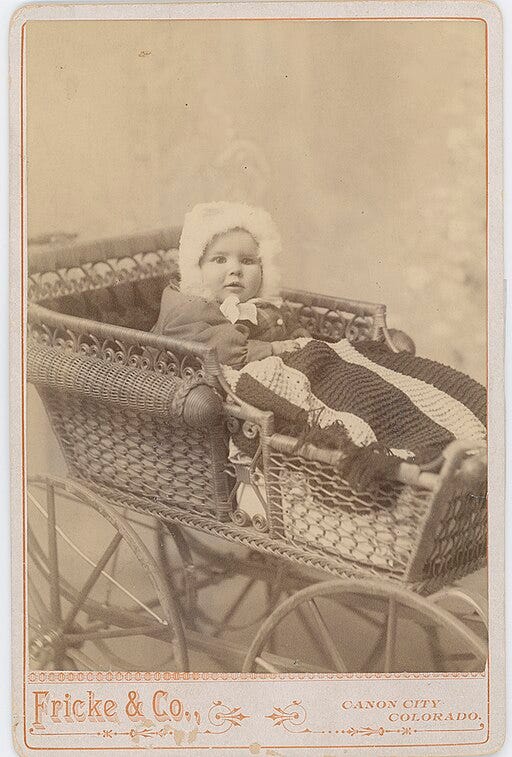
The year was 1961, but the baby carriage was a model from the 1950’s that had served for my other younger sister and me. It had big rubber tires and wheels with silver spokes, excellent suspension, and a seat like a throne. This one was covered with yellow, marbled vinyl and had a plastic strap with clasp to hold baby in place. Could the seat be adjusted so baby could lie down? I don’t remember.
That day my sister was sitting and I was pushing, my hands clasped to the chrome handlebar. The carriage was big, the handlebar high, and my head barely rose above it.
Then as now, I liked to walk. My mother had asked me to push my sister up and down the sidewalk in front of our house on Edwards Avenue in the Greenwood Hill section of Pottsville. That was boring. I wanted to go further, see more. When I got to the corner of the street, I turned left onto Fleet Street and began heading downhill.
I first had to cross the alley behind our street. That was easy. On each side was a garage and no curb. I easily rolled the carriage from one side to the other.
Soon, though, I arrived at an intersection with a wider, busier street. I had to lower the carriage from the curb to the macadam road. I didn’t do a good job. My sister lurched forward and almost fell out.
When I arrived at the opposite side of the street, the curb was high, too high. Pushing down on the handlebar with all my might, I could not get the front wheels to rise from the road up onto the sidewalk, which itself presented a series of obstacles. The roots of maple trees had broken through the concrete, creating a landscape of crags and ravines. My child’s strength was not enough for such terrain and who knew what the ups and downs would do to my sister!
I concluded that, despite the traffic, big two-toned sedans, the occasional delivery truck, the street was best.
Steering away from the curb into the street, I began to push the stroller up the hill of a side street, less busy than the one I had just crossed. I was halfway up when a woman came out of the corner house whose yard ran up the same hill. She called to me and told me to stop. Naturally, I obeyed.
She had black hair partially covered by a bandana tied at the back of her neck. It must have been summer because she was wearing a sleeveless blouse and shorts. I knew who she was. New to the neighborhood and perhaps to our town, she, her husband and their son had recently moved in. Her husband was a science teacher at Patterson School and an assistant to the high school football coach.
She came to the sidewalk. She asked me if my mother knew I pushed the baby carriage in the street.
I answered, “Yes, she told me to.”
I pushed to the top of Fleet Street Hill and then, after another alley, was able to get back on the sidewalk. Better to stay there and keep out of trouble. Somehow I managed to get back home.
Sometimes my mother pushed the baby carriage and we went for a walk together. My mother navigated the curbs with ease. No bumps or jolts for my baby sister. My other sister and I each held one side of the handlebar, helping to push.
That day we were following the exact same route as when I had disobeyed my mother and taken my sister far from home. Having reached the curb that defeated me, my mother pressed with one foot on a bar at the back of the stroller. The front wheels rose, connected with the curb, and with one push, my mother had the carriage on the sidewalk.
She slalomed between the crags and ravines of the broken concrete and did not stop until we came nose-to-nose with the woman who had questioned me.
No bandana, red lipstick, a dress. She was heading out to shop. She introduced herself to my mother, who in turn introduced us. The woman pretended not to know me. Then she told us an instructive tale about a little girl she had recently met.
My mother listened, my sisters got restless, and I stood still as a statue, gripping the handlebar.
The little girl in question was taking her baby sister for a walk. She was pushing her up this very hill. And she was walking almost in the middle of the street, risking the life of her sister and her own. Why, if a car had suddenly come over the crest, the driver would not have had time, in such a narrow street, to avoid hitting them.
Worst of all, when our new neighbor advised her to get out of the street, the little girl responded that her mother told her to walk there!
My mother shook her head. How could any mother give a child such advice. It was downright criminal! Mothers like that should be locked up in jail.
My mother and the other woman stared knowingly at each other and then their eyes fell on me. They knew, I knew, who they were talking about.
The two women said goodbye and we continued our walk. My mother didn’t have to say anything. I was overwhelmed by shame.
Back then, it was awful to have done wrong and be found out in a lie.
Now it is different. Shame has changed sides. The liars are cocksure and arrogant. They don’t lie, popular wisdom would have it. They create “narratives” that, shared millions of times, take on their own reality.
“Flood the zone with shit,” says one of our era’s preeminent strategists, striving for a world where truth will no longer matter.
And I feel ashamed. I feel ashamed of such a quote. I feel ashamed because I don’t know how to combat the dunghill of lies threatening to bury us all.
My sole consolation: “The truth will set you free.”
Great read.
Mine too.