

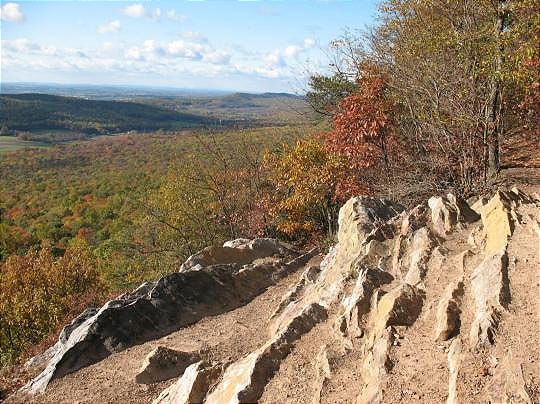
If you’re in your car heading north on Route 61, after driving through Port Clinton, PA, keep your eyes peeled for a right turn onto a dirt road. Once out of town, put on your turn signal and don’t speed up. You have to be quick not to miss it. Turning off the asphalt onto dirt and gravel, you begin the climb.
You’re “going up the Weiser.” Forest, some logging, scattered campsites, lots of rock, rattlesnakes and copperheads. You are entering the Port Clinton Tract of Conrad Weiser State Forest, covering seven counties, 38,000 acres, and sixteen tracts.
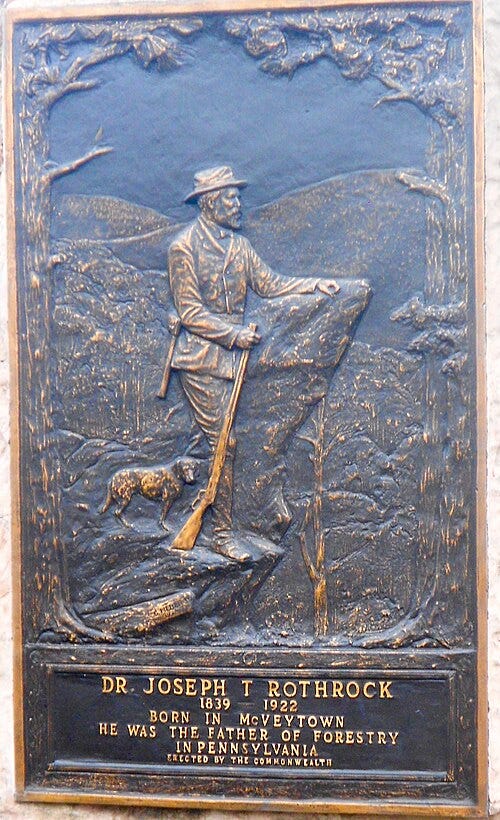
For this abundance, this beauty, this natural resource that benefits us all, we can thank Joseph T. Rothrock, the first president of the Pennsylvania Forestry Association, which he helped found in 1886. Appointed Pennsylvania Commissioner of Forestry in 1895, he initiated a state drive to purchase devastated lands from logging companies and became a pioneer of environmental restoration and conservation.
On warm summer nights, we go up the Weiser and picnic in a clearing overlooking the Kittatinny Ridge. One or two campsites may be occupied, but if we walk deeper into the forest, we are alone. In these woods, we’ve spotted scarlet tanager and wood thrush. Night falls, stars appear. We’re swatting at mosquitos. Time to pack up and go home. We hear a screech-owl as we climb back in the car.
Nearly three hundred years ago, when Conrad Weiser roamed these woods, a wave of religious enthusiasm swept the colonies of Pennsylvania, New Jersey, New York and Massachusetts, before spreading further south. To give an idea of its intensity, here is a comparison: this spiritual zeal far surpassed the greed which, a century later, possessed men’s hearts at the time of the Gold Rush. In the 1730’s and 40’s, God, not Mammon, acted so powerfully upon men and women’s souls that they were ready to give their all to Christ.
This became known as the First Great Awakening, religious fervor so powerful it set the colonies on fire, the first humble spark kindled by a family of Presbyterian pastors teaching at the “Log College” in New Jersey. The preachers’ humble log-cabin school became Princeton University.
Conrad Weiser was a part of this.
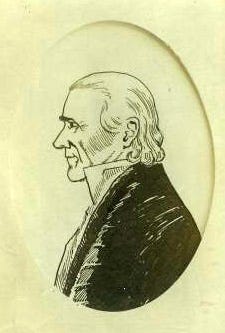
How many lives did Conrad Weiser live? Who today would have the courage, the simplicity, the fortitude, to live as he did?
Conrad Weiser was born in 1696 in Affstätt, a village in southern Germany. His father was a soldier and when he left his regiment and returned to the family home, he fell on hard times. His wife died. He had no livelihood except soldiering. He and his children joined other refugees fleeing the devastation of war. The armies of Louis XIV had plundered their land during what became known as the Nine Years’ War.
First the Weisers trekked across Germany to the North Sea. Then they sailed to England, then, in 1710, to the New World and the colony of New York. Refugees, immigrants, the Weiser family settled in the Mohawk Valley. The father could not feed his children. When a Mohawk chief approached him, offering to take care of his son Conrad, who would have to leave his family and live with the tribe, the father accepted.
For one year, in the Schoharie Valley of New York, Weiser lived and learned the Mohawk language and ways. Throughout his life, he would learn other native languages and was a constant friend of Native Americans.
Archeological evidence attests that the Iroquois Confederacy, of which the Mohawks were a part, came into existence in the mid-15th century. The Iroquois had a long established claim to their lands in North America. Immigrants, those we call “colonists,” pushed them out. Smallpox brought from Europe was a greater arm than any shotgun.
What would blood-and-soil Americans do if such aggressive and potentially lethal immigrants arrived in the United States today?
Immigrant Conrad Weiser befriended Native Americans. They placed their trust in him.
On November 20, 1720, Weiser married Anna Eve Feck, born on American soil in Schoharie County in 1705. In 1729, with their children, they sailed down the Susquehanna River, heading south to the colony of Pennsylvania. Can we, in the 21st century, conceive of the dangers and hardships of such a journey, the sheer difficulty? How did they sleep, eat, keep warm? Where did they relieve themselves? In the living waters? Imagine going into the woods at night. The forests were alive.
I do not know where they left the Susquehanna to begin their overland trek. It ended when they settled in the Tulpehocken Valley, on Tulpehocken Creek, a tributary of the Schuylkill River, in what is today the town of Womelsdorf, PA. To get there, they had travelled by land and water, through thick forests, for at least 300 miles.
Conrad and Anna had fourteen children. Only seven survived. Anna was of a strong constitution. She lived until 1781, the early days of the American republic. Her husband died in 1760.
For a while, in the 1730’s, Conrad Weiser left his family and retreated from the world.
The Charter of Privileges, signed by William Penn on October 28, 1701, offered religious freedom to all settlers in the colony of Pennsylvania. This was one of the foundational pillars of Penn’s “Holy Experiment,” where, on his lands, all religious dissenters could find a home.
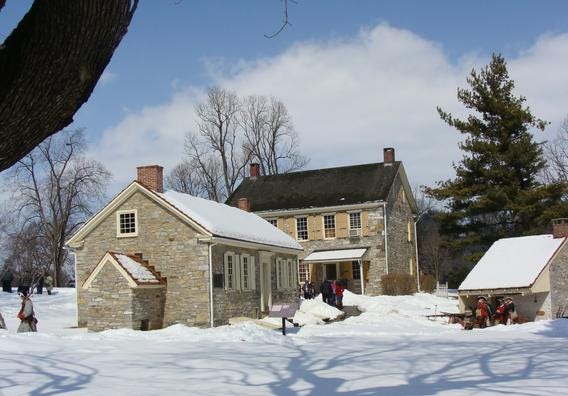
And many did. One was Conrad Beissel born in Eberbach, Germany. His father, a baker, died before his birth. Beissel was of peasant stock. He was destined for hard physical labor, not instruction, but he was bright and determined. He studied to become a Lutheran pastor. In 1720, he left Germany for Pennsylvania. In 1732, on the banks of Cocalico Creek in today’s Lancaster County, he founded the “Camp of the Solitary,” Ephrata Cloister.
Beissel sought to live as a hermit, leading a life of prayer and labor. He believed the Second Coming was near. He was charismatic and dogmatic, gathering around him a monastic community of eighty celibate Brothers and Sisters. Families were also invited to live according to the community’s dictates, but they remained outside, Householders living on nearby farms.
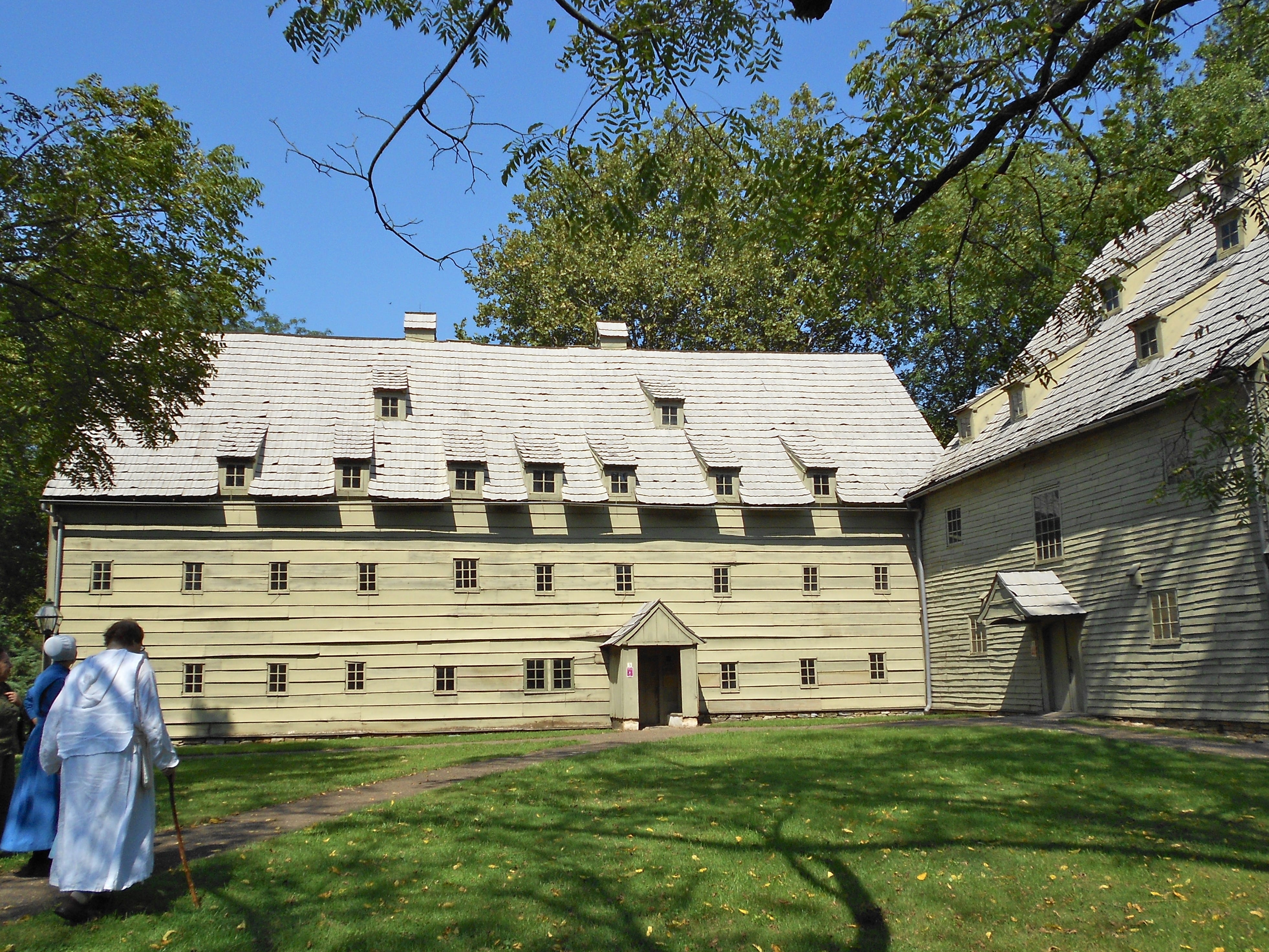
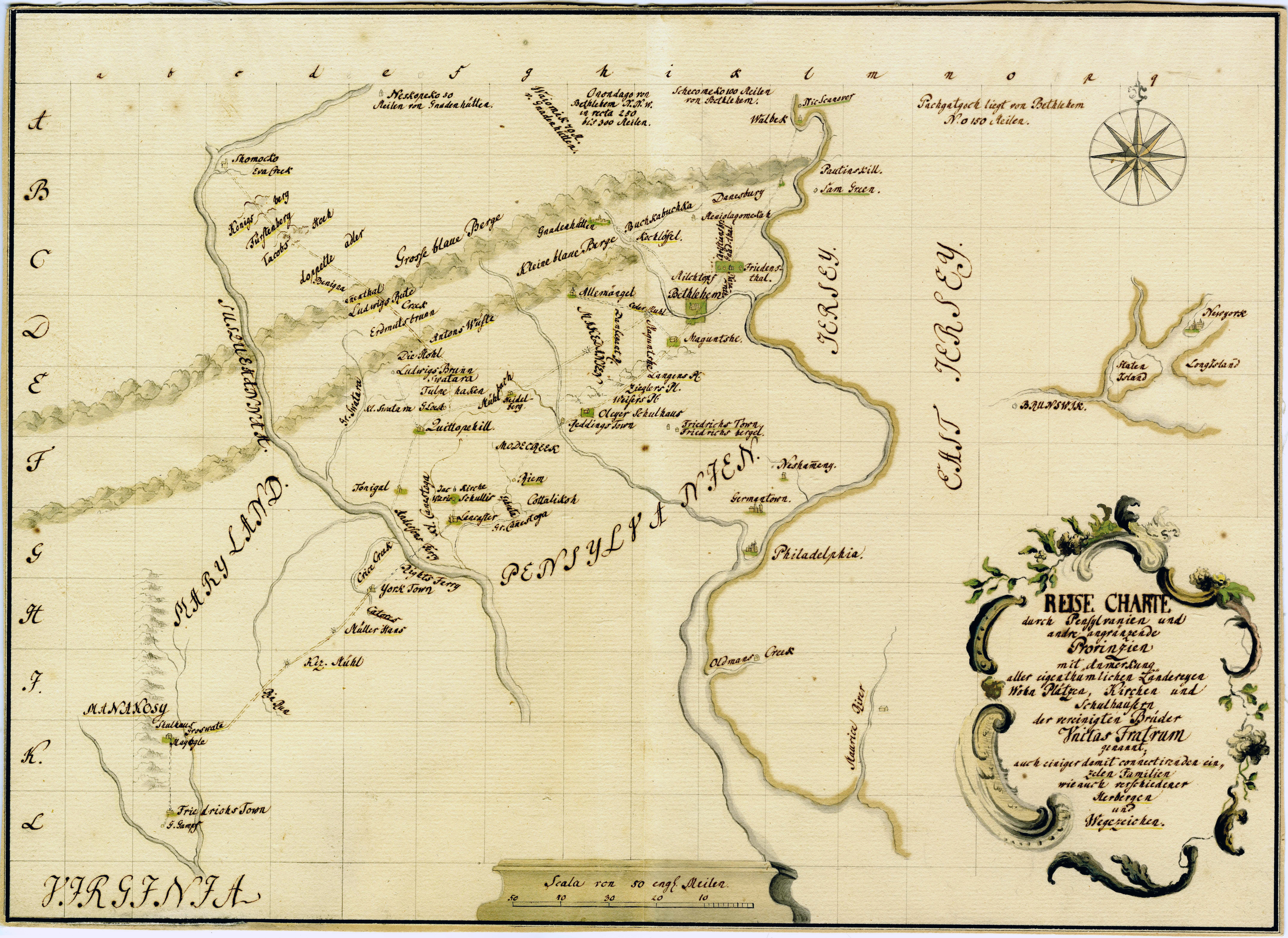
Beissel established a way of life similar to that of Saint Anthony of the Desert, the very saint who, before the discovery of coal, had given his name to the hinterland beyond Philadelphia, which included what is Schuylkill County today, Antons Wüste, Saint Anthony’s Wilderness.
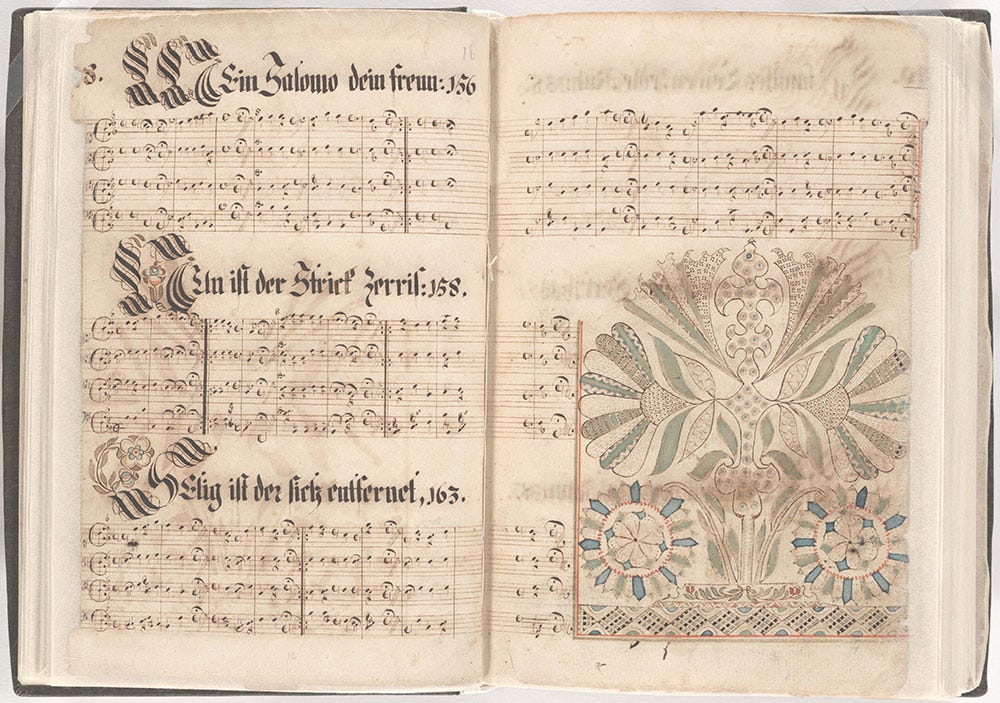
Those who lived within the Ephrata community practiced celibacy, asceticism, and private prayer. They slept little and worked hard as farmers, millers, weavers, carpenters and printers. In fact, Ephrata Cloister had one of the most important print shops in all the thirteen colonies and the Brothers and Sisters excelled in the art of Frakturschriften, calligraphy that included Biblical illustrations and drawings of plants and animals.
They also followed a strict vegan diet, which excluded all animal products, including eggs and honey. They lived on buckwheat, cabbage, potatoes and green vegetables.
And they sang. Beissel composed over one thousand hymns according to his own composition method. Specialists consider it a precursor to the serial music of the 20th century, be it the compositions of Arthur Schoenberg or jazz and rock. The Ephrata Cloister Chorus sings Beissel's music.
Quite a legacy. And Conrad Weiser, in the early years of the community, was a part of it. He lived as a Brother. His family remained on the banks of the Tulpehocken. This was a time of religious awakening, but it was also the Age of Reason, where God’s existence, some maintained, could be proven by logic, and religion was little more than adherence to a moral code. Turning his back on such doctrines, Weiser retreated from the world, seeking Christ within.
Another deeply religious man convinced him to return. Weiser’s work was too precious. He was needed as an interpreter and diplomat. The other man was Augustus Spangenberg who, like Weiser, was born in Germany. Spangenberg dedicated his life to organizing the Moravian Church in North America. He led Weiser to Count Nicholas Zinzendorf, German aristocrat, Moravian missionary and bishop.
Conrad Weiser, the count and the count’s daughter Benigna would cross Antons Wüste together. They would follow trails through passes and over the Kleine blaue Berge and Grosse blaue Berge, Weiser leading the way, speaking with native tribes in their native tongue, but that’s a story for another time...
Back when I was in high school, we studied Pennsylvania history in ninth grade. We had a thick, old textbook with a green cloth cover. I don’t think I ever carried it home and I don’t think I learned anything in that class. I sat mid-classroom and spent most of my time exchanging notes with friends. I also drew in my notebook. I did not listen and I remember nothing, not a single fact about the history of Pennsylvania, which I considered one of the most boring subjects in the world.
I loved English class, I loved art. I remember reading “The Rime of the Ancient Mariner”— “water, water everywhere, nor any drop to drink.” I remember drawing my first still life, driftwood, seashells, set on a stand in front of the class.
Pennsylvania history? Zilch, nada.
One single memory, the day Miss Chadwick caught me passing a note and then read it to the class. It was about boys. Now there was a subject dear to my heart.
Almost sixty years later, Conrad Weiser, Conrad Biessel, Count Zinzendorf are as alive to me as if they were sitting in the room where I write. Their stories move me and seem vital to understanding who I am.
Better late than never, this is my Pennsylvania.
I spent a week at YMCA Camp Conrad Weiser in Berks County, and remained ignorant of the camp's namesake until your brief mention of Camp Conrad Weiser in your recently posted delightful history of Schuylkill County and until reading this remarkable biography. I also studied Pennsyvania History in 9th grade. I wasn't caught passing notes to my classmates, but I can assure you that I was measurably more inattentive in class than you were. Now, decades later, I have the pleasure of learning all about Conrad Weiser. Many thanks!